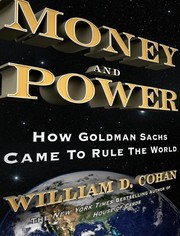
Money and Power: How Goldman Sachs Came to Rule the World
Summary
Cohan wrote a history of Goldman Sachs from Marcus Goldman through the 2008 crisis and the subsequent Congressional investigation, based on internal documents obtained through the Senate Permanent Subcommittee on Investigations and on extensive interviews.
The book's organising subject is conflict of interest. Cohan argues that Goldman's business model requires the firm to act simultaneously as adviser, market maker, principal investor and asset manager, and that these roles conflict structurally rather than occasionally. He works through the specific episodes: the Penn Central commercial paper default, the Robert Maxwell relationship, the Abacus transaction where Goldman constructed a mortgage security with input from a client who was shorting it, the firm's own mortgage short position in 2007 while selling mortgage products, and the AIG collateral calls.
He also covers the internal politics extensively, including the partnership fights, the Corzine and Paulson conflict, and the decision to go public.
Cohan's position is that Goldman's success comes substantially from information advantage arising from its position at the centre of every market, and that the firm manages conflicts by disclosure and by internal policy rather than by avoiding them. The book is long and the internal political detail is exhaustive. Compared with Ellis's authorised history it is far more critical and far better documented on the crisis period. Goldman disputes several characterisations, particularly on whether the firm had a directional short position or was managing residual risk, and that dispute is not resolvable from the public record.
Key takeaways 7
- Goldman's business requires it to act as adviser, market maker, principal investor and asset manager at once, and these roles conflict structurally rather than occasionally.
- The firm's advantage comes substantially from information generated by its position at the centre of markets rather than from superior analysis.
- Goldman reduced its mortgage exposure and took short positions in 2007 while continuing to sell mortgage-related products to clients.
- Conflicts are managed through disclosure and internal policy rather than by declining the business, which places the burden on the client to understand the position.
- Collateral calls on AIG were driven by Goldman's marks on positions where no market prices existed, which made the firm's valuation judgement the trigger for a systemic event.
- Going public converted the partnership's unlimited personal liability into shareholder capital, which changed the firm's risk-taking incentives permanently.
- Goldman's political relationships, built through the movement of former partners into government, are part of its business model rather than incidental to it.
Who should read it
Investors and finance professionals who want the documented critical account of Goldman's conflicts and its position in the 2008 crisis.
About William D. Cohan
Financial journalist and former investment banker at Lazard, Merrill Lynch and JPMorgan Chase.
House of Cards reconstructs the ten days in which Bear Stearns lost its funding, hour by hour and from the people in the room, and remains the closest study of how a broker-dealer run actually proceeds. Money and Power and The Last Tycoons trace how Goldman Sachs and Lazard made money over decades, including the partnership economics and internal politics that decided who got paid.
Where it sits in the reference 3
Who recommended it 1 · 1 direct
Similar books 6
Chosen by shared topics, the entries that hold them, and the people who recommended both.