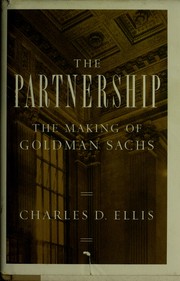
The Partnership: The Making of Goldman Sachs
The partnership form at its most profitable, and why it ended.
Summary
Ellis, who ran the consulting firm Greenwich Associates and knew the principals, wrote an authorised but not sanitised history of Goldman Sachs from Marcus Goldman's commercial paper business through the 1999 initial public offering and into the 2000s. The book is long and organised around individuals: Sidney Weinberg, Gus Levy, John Whitehead, John Weinberg, Robert Rubin, Steve Friedman, Jon Corzine and Hank Paulson.
The institutional themes are the useful ones. Ellis shows how the firm nearly died twice, with the Goldman Sachs Trading Corporation collapse in 1929 and the Penn Central commercial paper default in 1970, and how each near-death shaped subsequent risk practice. He documents the deliberate construction of the client-first culture under Whitehead, including the written business principles, and shows it was a commercial strategy for winning corporate relationships rather than an ethical position. He covers the shift from advisory and underwriting toward proprietary trading and principal investment, the fights over the partnership's capital adequacy that forced the flotation, and the internal conflict that removed Corzine.
For investors and operators the book is about how partnership economics shaped behaviour: partners had unlimited liability and their capital was locked in, which imposed risk discipline that the public company structure removed. Ellis is sympathetic to his subjects and had cooperation, so the treatment of conflicts of interest and of the firm's role in the events leading to 2008 is thin. The book was published in 2008 and the crisis material is minimal.
Key takeaways 7
- Goldman's client-first principles were adopted as a commercial strategy for winning corporate relationships, not as an ethical stance separate from profit.
- The partnership structure imposed risk discipline because partners carried unlimited liability and could not withdraw their capital, and going public removed that constraint.
- The firm's two near-death experiences, in 1929 and in the 1970 Penn Central default, shaped its risk culture more than any deliberate policy did.
- Refusing to participate in hostile takeover attacks was a positioning decision that won Goldman defence mandates from every large corporation.
- Recruiting and promotion, run as an intensive internal process with partners personally involved, was the firm's most sustained source of advantage.
- The move from agency businesses to principal risk-taking changed the firm's earnings from fee-based to capital-based and required permanent access to public equity.
- Goldman's compensation structure, which paid an unusually high share of revenue to employees, was the mechanism that retained talent and the reason returns to outside shareholders were modest.
Who should read it
Investors and finance operators interested in how partnership economics, culture and recruitment shape risk-taking inside a financial firm.
About Charles D. Ellis
Founder of Greenwich Associates; chair of the Yale endowment investment committee; author of 'The Loser's Game'
His 1975 essay 'The Loser's Game' is the primary source that reframed active management as a negative-sum contest, and the argument is still cited verbatim.
Where it sits in the reference 4
Who recommended it 1 · 1 direct
Similar books 6
Chosen by shared topics, the entries that hold them, and the people who recommended both.