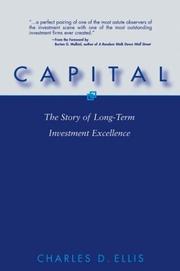
Capital: The Story of Long-Term Investment Excellence
History of Capital Group
Summary
Ellis wrote an institutional history of Capital Group, the Los Angeles fund manager that runs the American Funds, based on interviews and company records. It is an authorised account and Ellis had a long professional relationship with the firm.
The organisational design is the reason to read it. Capital runs what it calls the multiple portfolio counsellor system, in which a single fund is divided into segments and each is managed independently by a different portfolio manager, with a portion allocated to the research analysts directly. Ellis argues this solves several problems at once: it removes key-person risk, it allows the firm to grow assets without any individual managing more than they can, it lets managers with different styles coexist within one product, and it produces results that are more consistent than any individual would generate. He also documents the compensation system, which rewards long-horizon results measured over rolling multi-year periods rather than annual performance, and the private ownership structure that lets the firm avoid quarterly pressure.
Ellis also covers the distribution strategy through financial advisers rather than direct to retail, the deliberate refusal to launch products for market fashions, and the firm's international expansion.
The book is admiring and does not examine periods of underperformance seriously, nor does it engage with the question of whether the record survives fee and survivorship adjustment. Capital's active funds have faced the same pressure from indexing as everyone else since publication. The organisational design remains the durable contribution and it has been copied selectively elsewhere.
Key takeaways 7
- Dividing a single fund among several independently managed segments removes key-person risk and lets a firm grow assets without any manager exceeding their capacity.
- Compensating portfolio managers on rolling multi-year results rather than annual performance changes what positions they are willing to hold.
- Private ownership allows an asset manager to decline products that would sell well and perform badly, which a listed competitor cannot do.
- Distributing through financial advisers rather than direct to retail produces stickier assets, because the adviser relationship absorbs the client's reaction to drawdowns.
- Research analysts managing money directly, rather than only recommending, improves the quality of research because the analyst bears the consequence.
- Consistency of long-run results matters more to an asset gatherer than peak performance, because clients leave after drawdowns rather than after mediocre gains.
- An investment firm's organisational structure determines its results more reliably than the talent of any individual within it.
Who should read it
Asset managers and allocators interested in organisational design, manager compensation and how a firm scales investment capacity.
About Charles D. Ellis
Founder of Greenwich Associates; chair of the Yale endowment investment committee; author of 'The Loser's Game'
His 1975 essay 'The Loser's Game' is the primary source that reframed active management as a negative-sum contest, and the argument is still cited verbatim.
Where it sits in the reference 3
Who recommended it 1 · 1 direct
Similar books 6
Chosen by shared topics, the entries that hold them, and the people who recommended both.