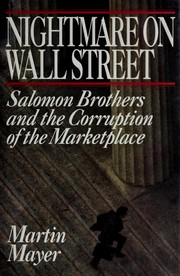
Nightmare on Wall Street: Salomon Brothers and the Corruption of the Marketplace
The Treasury-auction scandal and its aftermath.
Summary
Martin Mayer, who wrote about banking for four decades, covers the Salomon Brothers Treasury auction scandal of 1991 and the firm's near-destruction. Paul Mozer, who ran the government bond desk, submitted bids in customers' names without authorisation in order to exceed the limit on how much of an auction any single bidder could take.
Mayer's account covers the mechanics of the primary dealer system and the Treasury auction rules, which is necessary to see what Mozer did and why it mattered: cornering a specific issue lets the holder squeeze short sellers who must deliver that issue. He then covers the management failure, which is the part that nearly killed the firm. Mozer told his superiors, including John Gutfreund and Thomas Strauss, about one unauthorised bid in April 1991, and they did not report it to the authorities for months. When the matter became public the Treasury moved to suspend Salomon from auctions, which would have ended the firm, and Warren Buffett took over as interim chairman.
Mayer sets the episode inside a broader argument about the government securities market, which he considers under-regulated relative to its importance, and about a Wall Street culture in which trading profit justified conduct. He wrote close to events, before the full civil and regulatory record, and his verdicts on individuals reflect that. The book covers ground also treated in Michael Lewis's Liar's Poker, from a very different angle: Mayer is interested in market structure rather than in the trading floor.
Key takeaways 7
- Mozer submitted unauthorised bids in customers' names to exceed the limit on any single bidder's share of a Treasury auction.
- Cornering a specific Treasury issue lets the holder squeeze short sellers who are contractually obliged to deliver that issue.
- Salomon's senior management learned of an unauthorised bid months before reporting it, and that delay rather than the bid nearly destroyed the firm.
- Primary dealer status is a licence whose withdrawal would have ended Salomon immediately, which gave the Treasury decisive leverage.
- Buffett's intervention worked because his personal reputation substituted for the institutional credibility Salomon had lost.
- Mayer argues that the government securities market was regulated far more lightly than its importance to the financial system justified.
- A firm whose compensation rewards trading profit above all else will produce conduct its management claims not to want.
Who should read it
Investors and compliance professionals studying how a reporting failure rather than the original misconduct destroys a firm's regulatory standing.
Where it sits in the reference 2
Similar books 6
Chosen by shared topics, the entries that hold them, and the people who recommended both.