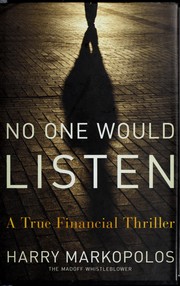
No One Would Listen
Memoir by the analyst who warned the SEC for nine years.
Summary
Harry Markopolos worked at a Boston options firm whose management asked him to replicate Bernard Madoff's returns. Within a few hours of examining the claimed strategy he concluded it could not produce the reported results, and he spent nine years attempting to persuade the Securities and Exchange Commission of that.
His analytical case is the most useful part. The split-strike conversion strategy Madoff claimed to run involves buying a basket of stocks and hedging with index options. Markopolos identified several impossibilities: the returns showed almost no correlation with the equity market, which the strategy could not produce; the options volume required to hedge the assets under management exceeded the total open interest on the exchange; the returns rose in a nearly straight line, which no strategy involving equities does; and the auditing firm was a two-person practice in a strip mall. He submitted documents to the Securities and Exchange Commission in 2000, 2001, 2005, 2007 and 2008.
The book is also an account of institutional failure and of the author's own state of mind, which included carrying a weapon and fearing for his family. Markopolos is not a neutral narrator; he is angry, self-regarding, and inclined to attribute the regulator's failure to stupidity rather than to the ordinary institutional causes. His congressional testimony and this book together produced substantial reform of the Securities and Exchange Commission's tip handling. Readers wanting the full Madoff story should read Henriques; this is the account of why the fraud was detectable from public information.
Key takeaways 7
- Madoff's reported returns showed a correlation with equity markets far too low for any strategy holding equities.
- The options volume required to hedge Madoff's stated assets exceeded the total open interest available on the exchange.
- A return series that rises almost without interruption indicates fabricated or smoothed marks rather than skill.
- Markopolos identified the fraud from publicly available marketing material in a few hours, which means every institutional investor could have.
- Feeder funds and their consultants had financial incentives that made investigating the returns unattractive.
- The Securities and Exchange Commission received detailed written submissions on five occasions and did not perform the custody check that would have ended the fraud.
- Regulators staffed with lawyers rather than with people who have traded cannot evaluate a quantitative claim about a strategy.
Who should read it
Investors and allocators who want a worked example of detecting an impossible return series from public information alone.
Where it sits in the reference 2
Similar books 6
Chosen by shared topics, the entries that hold them, and the people who recommended both.