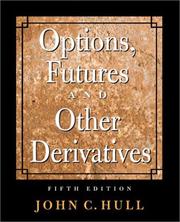
Options, Futures, and Other Derivatives
The universal graduate text on derivatives pricing.
Summary
John Hull's textbook has been the standard derivatives text since the late 1980s and is used in most finance master's programmes and in professional training. It covers the entire field from mechanics through to advanced modelling.
The early material covers the instruments and the markets: futures and forwards, the mechanics of exchanges, clearing, margin and settlement, hedging with futures, interest rates and swaps. The core covers option markets, the properties of option prices, trading strategies, the binomial tree, the Black-Scholes-Merton model and its derivation, the Greeks, and volatility smiles. Later chapters cover exotic options, interest rate derivatives and the term structure models, credit derivatives and credit risk, value at risk, and the estimation of volatility and correlation through GARCH and related methods.
Hull's method is to present the mathematics at a level a competent quantitative reader can follow, with worked numerical examples throughout. Editions have been revised repeatedly to add material on the 2008 crisis, on central clearing, on collateral and on the transition from LIBOR to risk-free rates, so the edition matters considerably for anything to do with discounting conventions. The book is a textbook, not a trading guide, and readers wanting practical volatility trading should supplement it with Natenberg.
Key takeaways 7
- Derivative pricing rests on no-arbitrage replication, meaning the derivative is priced by constructing a portfolio that reproduces its payoff.
- Risk-neutral valuation is a computational device rather than an assertion that investors are indifferent to risk.
- The binomial tree and the Black-Scholes equation are the same argument taken to different limits.
- Delta, gamma, vega, theta and rho decompose an option position's exposure into separately manageable sensitivities.
- The volatility smile shows that market prices reject the lognormal distribution the standard model assumes.
- Collateral and funding arrangements determine the correct discount rate for a derivative, which changed pricing conventions after 2008.
- Value at risk describes a loss threshold at a stated confidence level and says nothing about losses beyond it.
Who should read it
Anyone who needs a working technical command of derivatives, from pricing mechanics through to risk measurement, at the level the industry expects.
Where it sits in the reference 2
Similar books 6
Chosen by shared topics, the entries that hold them, and the people who recommended both.