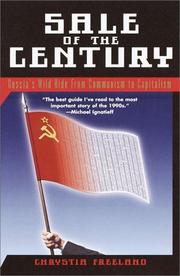
Sale of the Century
Loans-for-shares and the privatisation that created the oligarchs.
Summary
Chrystia Freeland ran the Financial Times bureau in Moscow during the 1990s and wrote this account of Russian privatisation and the rise of the oligarchs. She had direct access to the reformers and to the businessmen, and the book is built on that reporting.
The narrative covers the Gaidar price liberalisation of 1992, the voucher privatisation programme run by Anatoly Chubais, the emergence of the banks that became the oligarchs' vehicles, and the loans-for-shares scheme of 1995 in which the state's most valuable industrial assets, including Norilsk Nickel, Yukos and Sibneft, were pledged as collateral for loans and then transferred to the lenders through auctions the lenders themselves administered. She then covers the 1996 presidential election, in which the oligarchs funded Yeltsin's re-election campaign against a communist opponent who was leading in the polls, and the settling of accounts afterward.
Freeland's argument is that the reformers made a deliberate choice to create a propertied class quickly, on the theory that owners would defend private property and prevent a communist restoration, and that this succeeded in its immediate political objective while producing an economy owned by people whose titles rested on a transaction most Russians considered theft. She is sympathetic to the reformers' intentions and clear about the consequences. The book stops in 2000 as Putin took office. Its account of loans-for-shares is the standard one and remains directly relevant to understanding contemporary Russian political economy.
Key takeaways 7
- Loans-for-shares transferred Russia's most valuable industrial assets to a small group through auctions the buyers themselves administered.
- Reformers chose speed over legitimacy deliberately, believing that creating owners quickly would prevent a communist restoration.
- The oligarchs funded Yeltsin's 1996 re-election and were repaid with further assets and with policy influence.
- Voucher privatisation distributed nominal ownership widely and real control narrowly, because vouchers were bought up cheaply.
- Property titles created through a process most citizens considered illegitimate remained politically vulnerable, which later governments exploited.
- Banks profited enormously from handling government accounts and from the inflation of the early 1990s before acquiring industrial assets.
- Freeland argues that the reformers understood the corruption of the process and accepted it as the price of irreversibility.
Who should read it
Investors and analysts who need the origin of Russian corporate ownership and of the political vulnerability that still attaches to it.
Where it sits in the reference 2
Similar books 6
Chosen by shared topics, the entries that hold them, and the people who recommended both.