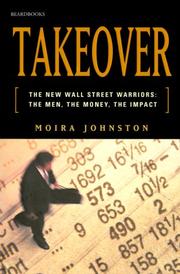
Takeover: The New Wall Street Warriors
Contemporary reporting on the raiders, including his Phillips Petroleum fight.
Summary
Johnston, a journalist, covered the mid-1980s takeover wave as it was happening, focusing on the individuals who conducted hostile bids and the defences deployed against them. The book was published in 1986, before the RJR Nabisco transaction and before the Drexel collapse.
The material covers the specific contests of the period and the techniques that emerged: the two-tier front-end-loaded tender offer, greenmail, the poison pill devised by Martin Lipton, the crown jewel defence, the white knight, the golden parachute, and the Pac-Man defence. She profiles the raiders including Carl Icahn, T. Boone Pickens, Sir James Goldsmith and Irwin Jacobs, the defence lawyers and bankers, and the target managements.
The underlying argument concerns whether the takeover wave was a corrective mechanism disciplining entrenched management, which is the position its defenders took, or a wealth transfer from employees, communities and bondholders to shareholders and financiers, which is what its critics argued. Johnston presents both, with sympathy for the disruption caused to the companies and their workforces.
The book is contemporaneous journalism rather than analysis, and its value is as a period document showing how the wave looked while it was running and before its outcome was known. The legal environment has changed completely since, particularly through Delaware case law on poison pills and board duties, so the tactical detail is historical. The reference has not verified the specific transaction figures.
Key takeaways 7
- The two-tier front-end-loaded tender offer coerced shareholders into tendering by threatening a worse outcome for those who held out.
- The poison pill, devised by Martin Lipton, gave boards the ability to make an unwanted acquisition prohibitively expensive without a shareholder vote.
- Greenmail transferred value from remaining shareholders to a single raider in exchange for going away, which was legal and widely practised.
- Golden parachutes were introduced to remove management's personal incentive to resist a transaction that benefited shareholders.
- Takeover premiums came partly from correcting undervaluation and partly from transfers away from bondholders, employees and pension funds.
- The takeover wave depended on the availability of high yield financing, which allowed acquirers far smaller than their targets to bid credibly.
- Defence tactics developed faster than the attacks, so each innovation in bidding produced a corresponding defence within a year or two.
Who should read it
Readers interested in a contemporaneous account of the 1980s takeover wave and the origin of the defensive tactics still in use.
Where it sits in the reference 4
Similar books 6
Chosen by shared topics, the entries that hold them, and the people who recommended both.