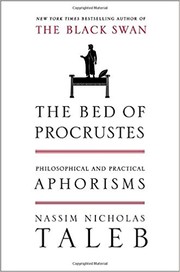
The Bed of Procrustes
Incerto volume 3; aphorisms
Summary
Taleb's book of aphorisms is the shortest volume in his Incerto series and states his positions without the argument and evidence that fill the other books. The title refers to the Greek figure who stretched or amputated guests to fit his bed, which Taleb uses as his image for forcing reality to fit models rather than adjusting the models.
The aphorisms cover the recurring subjects of his work: the distinction between what is measurable and what matters, the difference between knowledge from practice and knowledge from theory, the mechanisms of self-deception, the corruption of institutions by people who bear no risk, and the properties of systems that gain from disorder.
Specific lines that circulate widely include the observation that the person who has fewer options thinks more clearly, that what is not intelligible to a person is not necessarily unintelligent, that the opposite of success is not failure but the pursuit of a narrow definition of success, and various formulations about the difference between the visible and the consequential. There are also aphorisms on modernity, on the difference between ancient and contemporary conceptions of a good life, and a substantial number of attacks on academics, economists and journalists.
The form provides no argument, so a reader cannot evaluate any claim. Readers unfamiliar with Taleb's other work will find much of it opaque, since the aphorisms compress arguments made elsewhere. Some are sharp and some are simply insults. It works as a supplement for readers who have read the other volumes and as a source of compressed statements of positions argued at length elsewhere.
Key takeaways 8
- Forcing reality into a model, rather than adjusting the model, is the recurring error the title names.
- What is measurable and what matters are frequently different, and institutions optimise for the first because the second cannot be reported.
- Knowledge acquired through practice differs in kind from knowledge acquired through theory, and the second is systematically overvalued.
- A person with fewer options reasons more clearly, because the absence of alternatives removes the incentive to rationalise.
- Institutions are corrupted by people who make decisions without bearing the consequences, which is the central argument of Taleb's later work.
- Success defined narrowly and pursued single-mindedly produces a worse outcome than failure at a broader definition.
- The aphoristic form states positions without argument, so readers cannot evaluate any of the claims from this book alone.
- The material compresses arguments made at length in Taleb's other volumes and will be opaque to readers who have not read them.
Who should read it
Readers already familiar with Taleb's arguments who want them compressed, not a starting point for anyone new to his work.
About Nassim Nicholas Taleb
Former options trader; Distinguished Professor of Risk Engineering, NYU Tandon; scientific adviser to Universa Investments
The Incerto is the primary source for how markets and institutions handle tail risk, and the accompanying technical work supplies the mathematics others cite.
Where it sits in the reference 1
Who recommended it 5 · 2 direct
Similar books 6
Chosen by shared topics, the entries that hold them, and the people who recommended both.