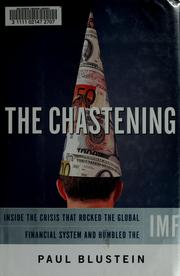
The Chastening
The IMF inside the 1997 crisis, reported from the negotiating rooms.
Summary
Paul Blustein, a Washington Post economics correspondent, reported this account of the International Monetary Fund's handling of the crises of 1997 and 1998 with unusual access to the institution and to the officials involved.
The narrative follows the sequence: Thailand's devaluation and the first programme, Indonesia's collapse and the political conditions attached to its programme, Korea's reserve exhaustion and the Christmas 1997 rescue in which foreign banks were persuaded to roll their loans, Russia's default and devaluation in August 1998, and Brazil's programme afterward. Blustein reconstructs the internal debates, the disagreements between the Fund, the United States Treasury and the affected governments, and the decisions made under time pressure with inadequate information.
His assessment is critical but not hostile. He documents the specific errors: fiscal tightening in economies whose deficits were private, high interest rates that deepened corporate insolvency, the Indonesian programme's structural conditions that extended far beyond the Fund's competence and destabilised the government, and the bank bailouts that protected foreign lenders while borrowers bore the adjustment. He also shows the constraints the Fund worked under, including its shareholders' politics and the absence of any alternative institution. The book is the best available account of how these decisions were actually made, and it shaped the subsequent reform of Fund conditionality.
Key takeaways 7
- The Fund required fiscal tightening in economies whose deficits were private rather than public, which deepened the contraction.
- High interest rates intended to defend currencies accelerated corporate insolvency, which was the actual problem.
- The Indonesian programme's structural conditions extended far beyond the Fund's competence and contributed to political collapse.
- Korea's rescue worked because foreign banks were persuaded to roll their loans, which was a private negotiation rather than a Fund programme.
- Fund programmes protected foreign creditors while domestic borrowers and workers bore the adjustment cost.
- Blustein documents that decisions were made under severe time pressure with information the Fund knew to be inadequate.
- The Fund's shareholders' politics constrained what it could do as much as its economic analysis did.
Who should read it
Investors and policymakers who want a documented account of how international crisis lending decisions are actually made under pressure.
Where it sits in the reference 2
Similar books 6
Chosen by shared topics, the entries that hold them, and the people who recommended both.