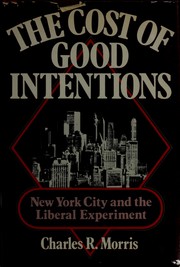
The Cost of Good Intentions
Contemporary anatomy of the same fiscal crisis, written from the numbers.
Summary
Charles Morris worked in New York City government and wrote this account of the city's fiscal crisis of 1975, tracing its origins through the John Lindsay administration of 1966 to 1973 and its resolution afterward.
His argument is that the crisis was produced by well-intended policy rather than by corruption or incompetence in the ordinary sense. The city expanded services, welfare provision, municipal employment and pension commitments during a period when its tax base was contracting through manufacturing decline and middle-class departure. Each individual expansion was defensible; the aggregate was not affordable. Morris documents the specific mechanisms: the collective bargaining settlements with municipal unions, the pension benefit increases whose costs fell outside the current budget, the expansion of the City University and of the municipal hospital system, and the accounting devices used to conceal operating deficits, including borrowing for operating expenses and recognising uncollectable revenue.
He then covers the crisis itself: the closure of the municipal bond market to the city in 1975, the creation of the Municipal Assistance Corporation and the Emergency Financial Control Board, the federal government's initial refusal and subsequent loans, and the union pension funds' purchase of city debt. The book is written by a participant with access and is one of the best accounts of a subnational fiscal collapse. Its analysis of how pension commitments hide costs outside the current budget applies directly to many governments now.
Key takeaways 7
- New York's fiscal crisis resulted from accumulated defensible commitments rather than from corruption or a single bad decision.
- Pension benefit increases moved costs outside the current budget, which made them the cheapest concession available in bargaining.
- The city borrowed for operating expenses and recognised uncollectable revenue, which concealed deficits until the market refused to fund them.
- Service expansion coincided with a contracting tax base as manufacturing left and middle-income residents departed.
- Loss of bond market access rather than any budget threshold is what converts fiscal deterioration into a crisis.
- Resolution required removing budget authority from elected officials and giving it to an appointed control board.
- Morris argues that municipal unions accepted the rescue because their pension funds held the city's debt.
Who should read it
Investors in municipal debt and analysts of public finance who want a detailed account of how a large city became insolvent and what resolution required.
About Charles R. Morris
Lawyer, banker and author on American finance and industrial history; died in 2021.
The Tycoons recounts how Carnegie, Rockefeller, Gould and Morgan assembled the industrial and financial structures of the American economy, with unusual attention to the financing and accounting they used to do it. The Sages compares the working methods of Buffett, Soros and Volcker against the crisis each of them read early.
Where it sits in the reference 2
Similar books 6
Chosen by shared topics, the entries that hold them, and the people who recommended both.