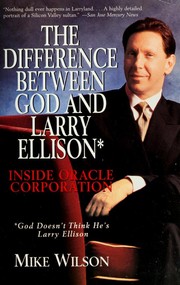
The Difference Between God and Larry Ellison
Unauthorised; Ellison tried to block it.
Summary
Wilson, a journalist, wrote an unauthorised biography of Larry Ellison and a history of Oracle from its 1977 founding through the mid-1990s.
The business material covers Oracle's origin in Edgar Codd's relational database papers, which IBM published and did not commercialise quickly, and Ellison's decision to build a product on them; the aggressive sales culture that made the company grow extremely fast; the 1990 crisis, in which revenue recognition practices that booked sales before they were realised produced a restatement, a share price collapse of about eighty percent and shareholder litigation; and the recovery under new financial management.
The revenue recognition episode is the most instructive part for investors. Oracle's sales organisation was compensated on bookings, contracts were written with terms that made the revenue uncertain, and the accounting recognised it anyway. The result was reported growth that was not real, followed by a correction when the receivables did not collect.
Wilson wrote without cooperation and the portrait of Ellison is unflattering throughout, covering the personal life, the disputed biographical claims and the litigation extensively.
The reference has not verified the specific claims in this account. The book is from 1997 and predates Oracle's applications business, the acquisitions of the 2000s, the cloud transition and Ellison's later career. Its value is the account of the growth-at-any-cost sales culture and the accounting crisis it produced.
Key takeaways 7
- Oracle built its product on relational database research that IBM published and did not commercialise quickly enough.
- Compensating a sales organisation on bookings rather than on collected revenue produces contracts written to close rather than to be fulfilled.
- Oracle recognised revenue on contracts whose realisation was uncertain, which produced reported growth that was not real and a restatement in 1990.
- The share price fell about eighty percent when the accounting was corrected, which shows the market had been pricing the reported growth.
- A company can grow extremely fast on an aggressive sales culture and simultaneously accumulate a receivables problem that is invisible in the income statement.
- Installing financial management with authority independent of the sales organisation was what allowed the recovery.
- The reference has not verified the specific claims in this unauthorised account.
Who should read it
Investors and operators interested in how sales compensation produces revenue recognition problems and in early Oracle history.
Where it sits in the reference 2
Who recommended it 1 · 1 direct
Similar books 6
Chosen by shared topics, the entries that hold them, and the people who recommended both.