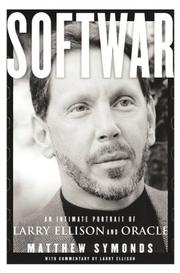
Softwar: An Intimate Portrait of Larry Ellison and Oracle
Authorised; Ellison's rebuttals run in footnotes throughout.
Summary
Symonds, an Economist journalist, wrote this with Ellison's cooperation under an unusual arrangement: Ellison could not change the text but could annotate it, and his footnotes appear throughout disputing the author's characterisations. The result is a biography with its subject arguing against it in the margins.
The business material covers Oracle's founding, the decision to build a commercial relational database based on the IBM research paper that IBM itself had not commercialised, the sales culture that produced both the growth and the 1990 accounting problems when revenue was recognised on contracts that had not closed, and the near-death that followed.
The strategic material covers Ellison's early argument that computing would move to a network model with applications delivered from central servers, which he pursued through the network computer initiative that failed and which describes what eventually happened; the shift to internet architecture in the late 1990s; the application suite strategy against SAP; and the hostile acquisition of PeopleSoft, which was in progress during the writing.
The internal material covers Oracle's own use of its software to consolidate its global operations, which Ellison presents as a demonstration and which required removing the autonomy of country managers. The cooperation arrangement makes the book unusual and also limits it, since Symonds had access on terms that shaped what he could establish. Ellison's footnotes are frequently the most revealing content. It covers a specific period and ends before the cloud transition and the hardware acquisitions.
Key takeaways 8
- Oracle built a commercial relational database from an IBM research paper that IBM had published and not commercialised.
- The sales culture produced both the growth and the 1990 accounting problems, when revenue was recognised on contracts that had not closed.
- Recognising revenue before contracts close produces reported growth that reverses, and the correction nearly destroyed the company.
- Ellison argued early that computing would move to a network model with applications delivered from central servers, which failed at the time and describes what happened later.
- Consolidating global operations onto a single system required removing the autonomy of country managers, which was the actual difficulty rather than the technology.
- An application suite from a single vendor competes against best-of-breed products on integration cost rather than on individual product quality.
- Hostile acquisition of a competitor removes a rival and acquires its customer base, which is the logic Ellison applied repeatedly.
- The book was written under an arrangement allowing Ellison to annotate but not change the text, and his footnotes disputing the author are frequently the most revealing content.
Who should read it
Readers interested in enterprise software strategy and in an unusual biographical format where the subject argues with the author throughout.
Where it sits in the reference 3
Who recommended it 2 · 1 direct
Similar books 6
Chosen by shared topics, the entries that hold them, and the people who recommended both.