The Ecological Vision
Essay collection; not returned by the Open Library author query
Summary
The reference has not verified this book in detail; the summary states only what the title, author and subject establish.
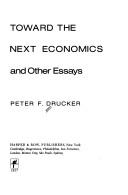
Peter Drucker collected these essays, written across five decades, on what he called social ecology: the study of how societies and their institutions work, which he considered his actual discipline rather than management.
The pieces cover a wide range. There are essays on economics and economists, including a critical assessment of Keynes and a treatment of Schumpeter that Drucker uses to argue that innovation and creative destruction matter more than equilibrium; essays on Japan and on the way Japanese institutions absorb change; essays on technology and its social consequences, including his argument that the industrial revolution's decisive innovation was the concept of the machine as a system rather than any particular device; and essays on individuals including Kierkegaard, Henry Ford and Alfred Sloan.
The collection is a better guide to how Drucker thought than to any particular subject. He treats management as a social function within a society of organisations rather than as a technical discipline, and these essays state that position most directly. They are also uneven, written for different audiences across fifty years, and several are of historical interest only. Readers wanting Drucker's management arguments should go elsewhere; readers wanting to understand his method may find this the most revealing of his books.
Key takeaways 7
- Drucker describes his own discipline as social ecology, meaning the study of how societies and their institutions actually function.
- He argues that Schumpeter's focus on innovation and creative destruction explains more than Keynes's focus on aggregate demand.
- The decisive innovation of the industrial revolution was the concept of a system of machines rather than any individual device.
- Management is a social function within a society of organisations rather than a technical discipline.
- Institutions rather than individuals are the units through which modern societies act, which is why their management is a social question.
- Drucker argues that economics treats the economy as a closed system while the important changes come from outside it.
- Technology's social consequences follow from how work is organised around it rather than from the technology itself.
Who should read it
Readers who want to understand how Drucker thought rather than what he recommended, and who accept an uneven collection spanning fifty years.
About Peter F. Drucker
Management writer and consultant; professor at Bennington, NYU and Claremont Graduate University
He invented management as a field of study, and The Practice of Management and The Effective Executive remain the primary sources every later writer builds on.
Where it sits in the reference 2
Similar books 6
Chosen by shared topics, the entries that hold them, and the people who recommended both.