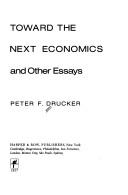
Toward the Next Economics and Other Essays
Summary
The reference has not verified this book in detail; the summary states only what the title, author and subject establish.
Peter Drucker collected these essays, written across the 1970s, on economics, on management and on the relationship between them. The title essay argues that the economic theory of the postwar period had exhausted itself and that a successor would have to account for productivity, for innovation and for the position of the firm, none of which Keynesian macroeconomics addressed.
Other pieces cover the multinational corporation and the changing structure of world trade, the productivity problem in developed economies, pension funds and their ownership of business, the management of service institutions, and Drucker's recurring argument that economists treat the economy as a closed system while the important changes arrive from outside it. There are also essays on individuals and on the intellectual history of economics, including his assessments of Keynes and Schumpeter.
As with Drucker's other collections, the pieces were written separately and repeat each other, and several are tied to conditions of the 1970s that no longer obtain. The essay on Keynes and Schumpeter states his position most directly: that Schumpeter's concern with innovation, entrepreneurship and structural change describes what actually determines economic outcomes, while Keynesian aggregate management addresses a narrower question. Readers wanting Drucker's arguments developed should go to the books.
Key takeaways 7
- Drucker argues that postwar economic theory could not account for productivity, innovation or the firm, which are what determine outcomes.
- Schumpeter's focus on innovation and structural change explains more than Keynesian aggregate demand management does.
- Economists treat the economy as a closed system while the changes that matter arrive from outside it.
- Pension funds had become the owners of business without acquiring any capacity to exercise ownership.
- Productivity in service work was the coming economic problem and no method for raising it existed.
- Multinational corporations were reorganising world trade in ways that national economic statistics did not capture.
- The essays repeat each other and several are tied to conditions of the 1970s that no longer apply.
Who should read it
Readers of Drucker interested in his criticism of economics as a discipline, though the books state his arguments more completely.
About Peter F. Drucker
Management writer and consultant; professor at Bennington, NYU and Claremont Graduate University
He invented management as a field of study, and The Practice of Management and The Effective Executive remain the primary sources every later writer builds on.
Where it sits in the reference 2
Similar books 6
Chosen by shared topics, the entries that hold them, and the people who recommended both.