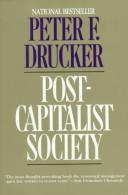
Post-Capitalist Society
Summary
Peter Drucker argues that the developed economies had passed through a transformation as significant as the industrial revolution, in which the primary economic resource ceased to be capital, land or labour and became knowledge. He calls the result the knowledge society and the book is his attempt to describe its institutions.
His argument about knowledge has three stages. Knowledge was applied first to tools and products, producing the industrial revolution; then to work itself, through Taylor's scientific management, producing the productivity revolution; and then to knowledge itself, producing the management revolution. In the resulting society the people who own the means of production are the knowledge workers who carry it in their heads, which changes the relationship between employer and employee fundamentally. He argues that the central management problem becomes the productivity of knowledge and service work, which nobody has yet solved as Taylor solved manual work.
The political sections argue that the nation state is losing capability upward to transnational structures and downward to regions, that the megastate built through the twentieth century has failed at most of what it attempted, and that the social sector of non-governmental organisations must take on functions the state cannot perform. Drucker also argues that pension funds owning corporations creates an unresolved governance problem. The predictions about knowledge work were largely correct; those about the state and about the social sector were not, or not yet. Drucker's insistence that knowledge workers must be managed as volunteers has been repeatedly confirmed.
Key takeaways 7
- Knowledge has replaced capital and labour as the primary economic resource in developed economies.
- Knowledge workers own their means of production and carry it with them, which reverses the employment relationship's traditional asymmetry.
- Raising the productivity of knowledge and service work is the central management problem and remains unsolved.
- Taylor's application of knowledge to manual work produced the twentieth century's productivity gains and is now exhausted as a source of further gain.
- The nation state is losing capability to transnational institutions above and to regional bodies below simultaneously.
- Pension funds own the corporations without any capacity or interest in exercising ownership, which leaves governance unresolved.
- Drucker argues that specialised knowledge is useless in isolation and productive only when integrated with other specialisms in an organisation.
Who should read it
Executives and investors who want Drucker's account of why knowledge work changes the employment relationship and what management problem it leaves unsolved.
About Peter F. Drucker
Management writer and consultant; professor at Bennington, NYU and Claremont Graduate University
He invented management as a field of study, and The Practice of Management and The Effective Executive remain the primary sources every later writer builds on.
Where it sits in the reference 2
Similar books 6
Chosen by shared topics, the entries that hold them, and the people who recommended both.