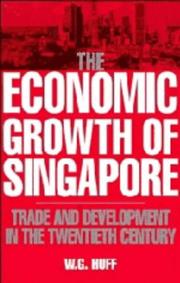
The Economic Growth of Singapore
The economic history: entrepot trade, forced saving and state-directed investment.
Summary
Gregg Huff wrote this economic history of Singapore from its founding as a British trading post in 1819 through the postwar period, and it is the standard scholarly treatment of the pre-independence economy.
The historical core concerns the entrepot trade. Huff explains how Singapore functioned as a collection and distribution point for the region's commodity exports, principally rubber and tin from Malaya and the Indonesian archipelago, and as a distribution point for manufactured imports. He documents the merchant houses, the Chinese business networks that connected the port to producers across Southeast Asia, the banking and shipping infrastructure, and the labour flows. He shows how this trade rather than any domestic production supported the island's income.
The later chapters cover the transition after separation from Malaysia in 1965, when the entrepot function alone could not employ the population, and the deliberate shift to export manufacturing through foreign investment. Huff addresses the question of whether Singapore's growth came from factor accumulation, engaging with the productivity debate that Alwyn Young and Paul Krugman raised, and his quantitative work is careful about it. The book is academic economic history with substantial data reconstruction. It is the best source on the period before the material that dominates popular accounts of Singapore.
Key takeaways 7
- Singapore's income before independence came from its entrepot function rather than from any domestic production.
- Chinese commercial networks connecting the port to producers across Southeast Asia were the infrastructure that made the entrepot trade work.
- Separation from Malaysia in 1965 removed the hinterland on which the entrepot function depended, forcing the shift to manufacturing.
- Export manufacturing through foreign investment was chosen because Singapore lacked both a domestic market and domestic industrial capital.
- Huff engages carefully with the argument that Singapore's growth reflected factor accumulation rather than productivity improvement.
- Rubber and tin from the region determined Singapore's income for a century, which made the economy dependent on commodity cycles.
- The colonial period built the port, banking and legal infrastructure that the independent state used rather than replaced.
Who should read it
Economic historians and analysts of Singapore who want the pre-independence foundation that popular accounts of the country omit.
Where it sits in the reference 2
Similar books 6
Chosen by shared topics, the entries that hold them, and the people who recommended both.