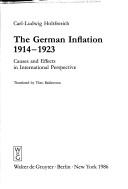
The German Inflation, 1914-1923
The revisionist case that the inflation had real benefits before it broke.
Summary
Carl-Ludwig Holtfrerich wrote the standard economic history of the German inflation, and his interpretation is more sympathetic to German policy than the accounts that treat the episode as a simple failure of monetary discipline.
His argument has several parts. He emphasises that the inflation until 1922 had real economic benefits for Germany: it maintained full employment while other economies suffered the 1920 and 1921 depression, it attracted large foreign capital inflows as speculators bought marks expecting a recovery, and it permitted reconstruction investment. He estimates the size of that capital inflow and argues that it constituted a substantial real transfer to Germany that partly offset reparations.
He also gives weight to the balance of payments explanation, in which the exchange rate depreciated first, driven by reparations transfers and by capital flight, with domestic prices and then money supply following. This runs against the pure monetary account and remains contested; Webb's econometric work finds causation running in both directions at different phases. Holtfrerich argues that German policymakers faced genuine constraints, that fiscal correction was politically impossible given the distributional conflict, and that the hyperinflation phase after the Ruhr occupation was a different phenomenon from the preceding inflation. The book is quantitative and scholarly and is the necessary counterweight to accounts that treat the episode as straightforward.
Key takeaways 7
- Holtfrerich argues that German inflation until 1922 maintained full employment while other economies suffered the 1920 depression.
- Foreign speculators bought marks expecting recovery, which produced a large real capital transfer to Germany.
- The exchange rate depreciated before domestic prices rose, which supports a balance of payments rather than a purely monetary explanation.
- Fiscal correction was politically impossible because the distributional conflict over who would pay could not be resolved.
- The hyperinflation after the Ruhr occupation was a different phenomenon from the inflation that preceded it.
- Reparations affected the currency principally through expectations about future budgets rather than through the transfers themselves.
- Holtfrerich's causal ordering is contested, and Webb's econometric work finds causation running in both directions at different phases.
Who should read it
Economic historians and investors who want the sympathetic scholarly interpretation of the German inflation to set against the monetary discipline account.
Where it sits in the reference 2
Similar books 6
Chosen by shared topics, the entries that hold them, and the people who recommended both.