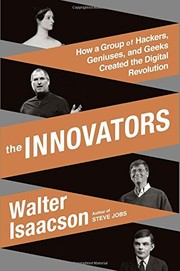
The Innovators
Collaboration, not lone genius, as the engine of the digital era.
Summary
Isaacson writes the history of computing as a sequence of collaborations rather than individual inventions, from Ada Lovelace and Babbage through to Google and Wikipedia. His organising argument is that innovation in this field came from teams combining different capabilities, and that the lone inventor account is consistently wrong.
The chapters cover Lovelace's recognition that a calculating machine could manipulate symbols rather than only numbers; the parallel development of computers by Atanasoff, Zuse, Turing, Mauchly and Eckert; the ENIAC programmers who were women and whose contribution was omitted from the record for decades; the transistor at Bell Labs and the collaboration between Shockley, Bardeen and Brattain; the integrated circuit developed independently by Kilby and Noyce; the founding of Intel; the microprocessor; the personal computer emerging from both the hobbyist counterculture and corporate research; ARPANET and the packet-switching design; the browser; and the collaborative production models of open source and Wikipedia.
His recurring theme is the combination of humanities and technology, which he treats as the source of the field's advances, and the pairing of a visionary with an operator, which he identifies in many of the partnerships.
Isaacson synthesises existing histories rather than doing original research, and specialists find each episode thin. The great-collaboration framing occasionally forces the material. His recovery of the ENIAC programmers and of Lovelace's contribution corrects a genuine omission in popular accounts. It works as a single-volume survey of where each component of modern computing came from.
Key takeaways 8
- Computing advanced through collaborations combining different capabilities rather than through individual invention, and the lone inventor account is consistently inaccurate.
- Ada Lovelace recognised that a calculating machine could manipulate symbols rather than only numbers, which is the conceptual basis of general-purpose computing.
- The ENIAC programmers were women whose contribution was omitted from the historical record for decades.
- The transistor came from a Bell Labs team combining theoretical and experimental physics with an explicit institutional structure for such collaboration.
- The integrated circuit was developed independently and nearly simultaneously by Kilby and Noyce, which is the standard pattern for major inventions.
- The personal computer emerged from the combination of hobbyist counterculture and corporate research, neither of which would have produced it alone.
- The internet's packet-switching design was chosen for resilience and distributed control, which determined the character of everything built on it.
- Open source and Wikipedia demonstrate that voluntary distributed production can outperform organised commercial development in specific conditions.
Who should read it
Readers who want a single-volume survey of where each component of modern computing came from, with the collaboration framing as the organising argument.
About Walter Isaacson
American biographer and professor of history at Tulane University; formerly editor of Time and chief executive of CNN and the Aspen Institute.
The biographies are built on long direct access - years of interviews with Jobs, then with Musk - and reconstruct how each subject decided, hired and treated the people around them. The Innovators does the same for computing, presenting it as a chain of collaborations rather than a sequence of lone inventions.
Where it sits in the reference 2
Who recommended it 5 · 1 direct
Similar books 6
Chosen by shared topics, the entries that hold them, and the people who recommended both.