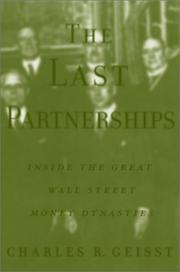
The Last Partnerships: Inside the Great Wall Street Money Dynasties
History of the private Wall Street houses, Salomon included; Open Library unreachable.
Summary
Charles Geisst, a financial historian, traces the private partnerships that dominated American investment banking from the early nineteenth century until they converted to public companies in the 1970s and after.
The firms he covers include Brown Brothers, Kidder Peabody, J. P. Morgan, Kuhn Loeb, Lehman Brothers, Goldman Sachs, Dillon Read, Lazard, Merrill Lynch and Salomon Brothers. For each he covers the founding, the family or partnership structure, the businesses they built and the competitive position each held. The recurring themes are the ethnic and social divisions of Wall Street, particularly between the German-Jewish houses and the Yankee firms, which determined which clients each could serve; the relationship between partnership capital and risk appetite; and the succession problem that partnership structures create.
Geisst's argument is that the partnership form disciplined risk-taking because partners' personal wealth was at stake and was locked in the firm, and that its abandonment in favour of public ownership transferred risk to outside shareholders while leaving compensation with employees. The book was published in 2001, before the failures of 2008 demonstrated the point comprehensively. It is descriptive history rather than analysis and covers a great deal of ground quickly, but the argument about the partnership form has been widely adopted since.
Key takeaways 7
- Partnership structures disciplined risk-taking because partners' personal wealth was at stake and was locked into the firm.
- Converting to public ownership transferred risk to outside shareholders while leaving compensation with employees.
- Ethnic and social divisions on Wall Street determined which firms could serve which clients for a century.
- Partnership capital was permanent but limited, which constrained the scale of risk any firm could take.
- Succession is the structural weakness of a partnership, since retiring partners withdraw capital the firm needs.
- Geisst argues that the incentive change from partnership to public ownership explains much of the subsequent behaviour of investment banks.
- The competitive positions of the major houses were established in the nineteenth century and persisted for generations.
Who should read it
Readers of Wall Street history who want the institutional origins of the major firms and the argument about what the partnership form disciplined.
Where it sits in the reference 2
Similar books 6
Chosen by shared topics, the entries that hold them, and the people who recommended both.