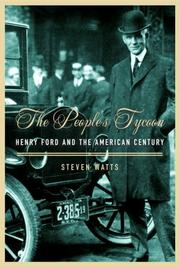
The People's Tycoon: Henry Ford and the American Century
Scholarly biography placing Ford in American cultural history.
Summary
Steven Watts, a cultural historian, wrote this biography of Henry Ford treating him as a figure who shaped American culture as much as American industry.
The business material covers the founding of the Ford Motor Company, the Model T and the decision to make one product at continuously falling prices, the moving assembly line at Highland Park, the five-dollar day of 1914 and the Sociological Department that investigated employees' private lives to determine eligibility for it, the River Rouge complex and its vertical integration from ore to finished car, the refusal to change the Model T until share loss forced the Model A, and the labour conflict of the 1930s including the Service Department under Harry Bennett and the violence at the Battle of the Overpass.
The cultural material is Watts's distinctive contribution. He treats Ford as a figure who combined mass production with an ideology of rural virtue, whose public persona as a plain-speaking mechanic was constructed and enormously effective, and who used that standing to promote positions including pacifism, the peace ship, and the antisemitism published in the Dearborn Independent and in The International Jew, which Watts covers directly rather than in passing. He examines the contradiction between Ford's celebration of the individual craftsman and the work he actually created. The book is long and well researched and is the standard modern biography.
Key takeaways 7
- Ford's strategy was one product at continuously falling prices, which required engineering the manufacturing process rather than the car.
- The five-dollar day reduced turnover enough to pay for itself and came with intrusive investigation of employees' private lives.
- River Rouge integrated production from ore and rubber through to finished vehicles, which was the furthest extent of industrial vertical integration.
- Refusing to change the Model T cost Ford market leadership to General Motors, which offered variety and annual change.
- Ford's public persona as a plain-speaking mechanic was deliberately constructed and gave him standing to promote political positions.
- Ford published sustained antisemitic material in the Dearborn Independent, which Watts treats directly rather than as a footnote.
- Ford celebrated the individual craftsman while creating work that eliminated craft entirely, and Watts treats the contradiction as central.
Who should read it
Readers of business history who want a full account of Ford including the cultural and political dimensions that operating histories omit.
Where it sits in the reference 2
Similar books 6
Chosen by shared topics, the entries that hold them, and the people who recommended both.