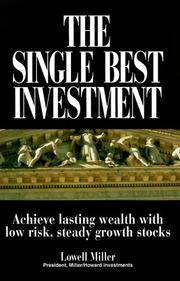
The Single Best Investment
Miller on buying rising-dividend businesses and holding them.
Summary
Lowell Miller ran a money management firm and wrote this as an argument for dividend growth investing, meaning buying high-quality companies with above-average dividend yields that raise those dividends consistently.
His formula is stated as high quality plus high current yield plus high growth of yield. Quality means a business with durable competitive position, conservative finances and a long record; high current yield means meaningfully above the market average, which he treats as a valuation discipline; and dividend growth means a company raising its payment consistently, which he argues both compounds the income and drives the share price, since a rising dividend pulls the price up to maintain a market-consistent yield.
Miller's arguments include that dividends impose discipline on management, since cash paid out cannot be misallocated; that dividend-paying companies are self-selecting for the qualities investors want, because a company committing to a payment must have confidence in its cash generation; that the compounding of a rising income stream produces returns that do not depend on selling; and that the investor's psychology is easier to manage when returns arrive as cash rather than as price appreciation. The book is written for individual investors and is repetitive. Its arguments are not novel and the historical evidence on dividend strategies is more mixed than Miller allows, particularly regarding the tax treatment for taxable investors and the periods when dividend payers underperformed substantially.
Key takeaways 7
- Miller's formula combines business quality, an above-average current yield and a consistent record of dividend increases.
- A rising dividend pulls the share price up over time, because the market reprices the security to a consistent yield.
- Dividends impose discipline on management, since cash paid out cannot be reinvested badly.
- Committing to a dividend requires confidence in cash generation, which makes the payment itself a signal about the business.
- Returns arriving as cash are psychologically easier to hold through declines than returns arriving as price appreciation.
- An above-average yield functions as a valuation discipline that prevents overpaying for quality.
- The historical evidence on dividend strategies is more mixed than the book allows, particularly on tax treatment for taxable holders.
Who should read it
Individual investors building income portfolios who want the case for dividend growth stated as a complete method.
Where it sits in the reference 2
Similar books 6
Chosen by shared topics, the entries that hold them, and the people who recommended both.

