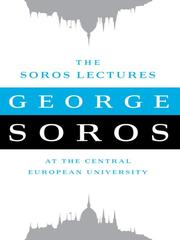
The Soros Lectures at the Central European University
Open Library lists the short title "The Soros Lectures".
Summary
George Soros delivered these five lectures in Budapest in 2009, and they are the most compact statement of the intellectual framework he has developed across several books.
The framework has two propositions. Fallibility: participants in a situation cannot have complete knowledge of it, because their own thinking is part of what they are trying to understand. Reflexivity: participants' misconceptions affect the situation itself, which then affects their thinking, so that a two-way feedback loop operates between perception and reality. Soros argues that this makes social phenomena categorically different from natural ones and that economics has erred fundamentally by modelling markets as if the two were alike.
The applications follow. Financial markets do not tend toward equilibrium; they produce boom and bust sequences in which a prevailing bias and an underlying trend reinforce each other until the divergence from reality becomes unsustainable. Soros describes the stages of such a sequence and applies it to the credit expansion that ended in 2008, which he treats as the culmination of a super-bubble developed over decades. The final lectures cover open society, the political philosophy he takes from Karl Popper, and his argument that markets require regulation because they are inherently unstable rather than despite being efficient. The lectures are short and abstract. Reflexivity has never been formalised in a way that generates testable predictions, which is the standard objection and which Soros acknowledges.
Key takeaways 7
- Participants cannot have complete knowledge of a situation they are part of, because their own thinking is among the things to be understood.
- Reflexivity means participants' misconceptions alter the situation, which then alters their thinking, producing two-way feedback.
- Financial markets do not tend toward equilibrium, because prices affect the fundamentals that prices are supposed to reflect.
- Boom and bust sequences follow a pattern in which a prevailing bias and an underlying trend reinforce each other until the divergence becomes unsustainable.
- Soros treats the 2008 crisis as the culmination of a credit super-bubble that developed over several decades.
- Markets require regulation because they are inherently unstable rather than because regulation improves on efficient outcomes.
- Reflexivity has never been formalised into testable predictions, which is the standard objection to the framework.
Who should read it
Investors who want the clearest short statement of reflexivity and of the boom-bust framework from the person who trades on it.
About George Soros
Founder, Soros Fund Management and the Quantum Fund; founder, Open Society Foundations
The Alchemy of Finance introduced reflexivity, a primary-source framework macro traders and academics still build on.
Where it sits in the reference 2
Similar books 6
Chosen by shared topics, the entries that hold them, and the people who recommended both.