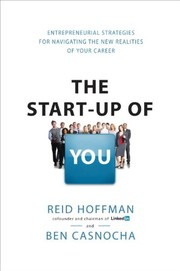
The Start-up of You
Summary
Hoffman and Casnocha argue that the career model built on stable employment and defined ladders no longer exists, and that individuals should manage their careers using the methods entrepreneurs use for startups. The book was written after LinkedIn's growth and draws on Hoffman's investing and operating experience. The framework has several components. Competitive advantage comes from the intersection of three elements: assets, meaning what you have including skills, cash and relationships; aspirations, meaning what you want; and market realities, meaning what people will pay for. They argue that people plan around the first two and ignore the third.
The ABZ planning method holds that a person should have plan A, the current course; plan B, an adjacent alternative that can be pivoted to using the same assets; and plan Z, a fallback that is survivable and that removes catastrophic risk from the other two. They argue that having a defined plan Z is what permits risk-taking in plan A.
On networks they distinguish strong ties from weak ties and argue that weak ties provide most new information and opportunities because they connect to different circles. They advocate building relationships before they are needed and giving before asking. On risk they argue that most people overestimate career risk and underestimate the risk of stability, and they advocate intelligent risk-taking with defined downside limits and small experiments.
The book is short and the ideas are not original individually. It reads partly as an argument for LinkedIn as a tool. The advice presumes a knowledge-work career in a developed economy. The ABZ framing and the distinction between weak and strong ties are the parts readers use.
Key takeaways 8
- Career advantage comes from the intersection of your assets, your aspirations and what the market will actually pay for, and most people ignore the third.
- A person should hold a current plan, an adjacent alternative reachable with the same assets, and a survivable fallback that removes catastrophic risk.
- Having a defined fallback is what makes taking risk in the primary plan rational rather than reckless.
- Weak ties provide most new opportunities and information because they connect to circles that your close relationships do not reach.
- Relationships must be built before they are needed, because a network approached only at the moment of need does not respond.
- Careers should be treated as permanent beta, with continuous investment in skills rather than periodic retraining after a disruption.
- Stability carries risk that is invisible because it accumulates slowly, while the risks of change are visible and therefore overweighted.
- Small reversible experiments generate better career information than analysis or planning does.
Who should read it
Professionals managing their own careers who want a structured alternative to the ladder model, particularly the fallback-enabled risk framing.
About Reid Hoffman
Co-founder and former executive chairman of LinkedIn; partner at Greylock Partners; co-founder of Inflection AI
Blitzscaling and The Start-up of You outlived their news cycles and gave the industry durable vocabulary, on top of a first-rate operating and investing record.
Where it sits in the reference 2
Who recommended it 6 · 1 direct
Similar books 6
Chosen by shared topics, the entries that hold them, and the people who recommended both.