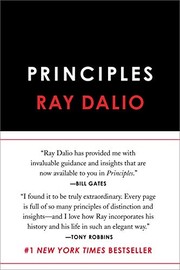
Principles: Life and Work
Insider: the founder's own statement of the management system.
Summary
Dalio sets out the decision rules he used to build Bridgewater Associates into the largest hedge fund in the world. The book has three parts: a short autobiography, a set of life principles, and a set of work principles. The life principles argue for radical truth and radical transparency, treating pain plus reflection as the source of progress, and running a five-step process of setting goals, identifying problems, diagnosing root causes, designing solutions and executing.
The work principles describe Bridgewater's internal machinery. Dalio explains believability-weighted decision making, in which votes count in proportion to a person's demonstrated track record in the relevant domain rather than in proportion to seniority. He describes the baseball cards and dot collector tools that record employees' attributes in public, recorded meetings, and the practice of criticising people to their faces. He argues that an organisation is a machine consisting of culture and people, and that the manager's job is to look down on the machine and redesign it.
The investing content is thinner than readers expect. Dalio describes the loss that nearly ended his career after his 1982 debt-crisis call went wrong, the resulting habit of stress-testing every view, and the holy grail of finding fifteen or more uncorrelated return streams. He does not disclose the models themselves.
The main dispute concerns whether the system is transferable. Bridgewater's culture selected hard for people who tolerated it, and reporting by Rob Copeland and others describes an environment far more centred on Dalio's personal authority than the book admits. Bridgewater's returns since 2012 have been unremarkable, which weakens the argument from results. Read the book as a description of one firm's operating system, not as a validated method.
Key takeaways 8
- Pain plus reflection produces progress, so a person should treat painful outcomes as the primary input to improving decision rules.
- Radical truth and radical transparency raise organisational performance because they surface errors instead of protecting egos.
- Decisions should be weighted by believability, meaning a person's recorded track record in that specific domain, rather than by rank or by equal votes.
- Any recurring situation should be turned into an explicit written principle so the same decision does not have to be made twice.
- An organisation works as a machine of culture plus people, and the manager's job is to design and repair that machine rather than to do the work inside it.
- Fifteen or more genuinely uncorrelated return streams reduce risk far more than concentrated conviction does.
- People differ in wiring in stable ways that testing can reveal, and roles should be matched to wiring rather than to ambition.
- Ego and blind spots are the two largest barriers to accurate thinking, and both require external checks because neither is visible from inside.
Who should read it
Operators designing decision processes and culture at scale, who can extract the transparency and believability mechanics without adopting Bridgewater's whole system.
About Ray Dalio
Founder and former co-CIO, Bridgewater Associates 1975-2022
Principles and the debt-cycle template are primary sources that a large secondary literature now builds on.
Where it sits in the reference 5
Who recommended it 31 · 2 direct
Similar books 6
Chosen by shared topics, the entries that hold them, and the people who recommended both.