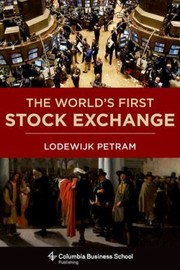
The World's First Stock Exchange
How VOC shares actually traded: brokers, forwards, options, settlement.
Summary
Lodewijk Petram researched the Amsterdam securities market of the seventeenth century for his doctorate and wrote this account of how trading in Dutch East India Company shares developed from the company's founding in 1602.
The historical finding is that essentially every feature of a modern securities market appeared in Amsterdam within a few decades. Shares became transferable and a secondary market developed. Forward contracts allowed trading for future settlement, which meant positions could be taken without capital. Options were written and traded. Short selling appeared and was prohibited in 1610, and the prohibition was ignored. A clearing arrangement developed to net positions between traders. Trading concentrated in specific locations and then in a purpose-built exchange, and information circulated through coffee houses and printed price lists. Petram documents the small group of traders who dominated the market and the way social networks determined who could obtain credit and settlement.
His sources are notarial records, court cases and personal papers, which is how he reconstructs transactions that the company's own records do not show. The book is scholarly and readable and its central contribution is showing that these instruments and practices are not modern innovations but emerged immediately once transferable shares existed. It also documents that the market's problems, including manipulation, settlement failure and disputes about short selling, appeared at the same time.
Key takeaways 7
- Essentially every feature of a modern securities market appeared in Amsterdam within decades of the first transferable shares.
- Forward contracts allowed traders to take positions without capital, which made leverage available from the market's earliest years.
- Short selling was prohibited in 1610 and the prohibition was ignored, which established the pattern for every subsequent attempt.
- Clearing arrangements to net positions between traders developed from practical necessity rather than from regulation.
- Options on shares were written and traded within the market's first decades.
- Social networks determined access to credit and settlement, which meant the market was open in form and closed in practice.
- Manipulation, settlement failure and disputes over short selling appeared at the same time as the instruments themselves.
Who should read it
Investors and financial historians who want evidence that modern market instruments and their problems emerged immediately once transferable shares existed.
Where it sits in the reference 2
Similar books 6
Chosen by shared topics, the entries that hold them, and the people who recommended both.