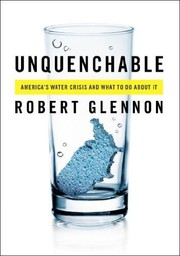
Unquenchable
Glennon's case for pricing and trading water rights.
Summary
Robert Glennon, a law professor specialising in water, argues that the United States faces a water crisis produced by law, pricing and subsidy rather than by physical scarcity.
His legal analysis is the book's distinctive content. Western American water rights operate under prior appropriation, in which the earliest claimant holds the senior right and use must continue or the right is lost, which creates an incentive to consume water rather than to conserve it. Groundwater is regulated separately and in several states barely at all, so that pumping is unconstrained even where it depletes the aquifer supplying surface flows. Agricultural water, which is the large majority of consumption, is priced far below its cost of supply through federal projects, which sustains low-value crops in arid regions.
The reporting covers specific cases: the Colorado River allocation which exceeds the river's actual flow, aquifer depletion in the High Plains and in the Southwest, bottled water extraction, water-intensive industry siting including data centres and ethanol plants, and the environmental consequences of flow depletion. Glennon's proposals are market-based: establish transferable water rights so that water can move to higher-value uses, price water at cost, and use the resulting revenue for infrastructure. He is critical of both supply expansion and of conservation appeals as substitutes for pricing. The book is accessible and the legal material is authoritative.
Key takeaways 7
- Prior appropriation water rights require continued use or the right is lost, which creates an incentive to consume rather than conserve.
- Groundwater is regulated separately from surface water and barely at all in several states, despite the two being physically connected.
- Agricultural water is priced far below its cost of supply, which sustains low-value crops in arid regions.
- Colorado River allocations exceed the river's actual average flow, which was known when the allocations were made.
- Glennon argues for transferable water rights so that water moves to higher-value uses without requiring administrative allocation.
- Conservation appeals and supply expansion are both substitutes for pricing and both fail for the same reason.
- American water scarcity is produced by legal and pricing arrangements rather than by physical availability.
Who should read it
Investors and operators with water-dependent operations in the United States, and anyone assessing water policy on economic grounds.
Where it sits in the reference 2
Similar books 6
Chosen by shared topics, the entries that hold them, and the people who recommended both.