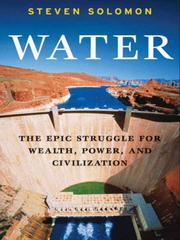
Water
Global history of water as the constraint on wealth and power.
Summary
Steven Solomon writes a global history of water and its relationship to political and economic power, from the earliest irrigation civilisations to the present.
The historical argument is that command of water has determined which societies prospered at each technological stage. Irrigation supported the first states in Mesopotamia, Egypt, the Indus valley and China, and the administrative requirements of managing it shaped their political forms. Maritime access determined which powers dominated trade, from the Mediterranean through the Atlantic to the age of steam. Canals and inland navigation shaped industrial development, and Solomon treats Britain's canal network and later the Erie Canal and the American river system as decisive. Hydroelectric power and large dams shaped twentieth-century industrialisation, particularly in the United States and the Soviet Union.
The final section concerns the present, where Solomon argues that water scarcity is becoming a binding constraint on economic growth and a source of political conflict in specific regions: the Middle East, the Indus basin, northern China, the American Southwest and parts of Africa. He treats agricultural water use, which is the great majority of consumption, as the point where policy must act. The book is long, sweeping and journalistic rather than scholarly, and its causal claims about water determining historical outcomes are stated more strongly than the evidence supports. The regional analysis of current scarcity is the more useful part.
Key takeaways 7
- Command of water determined which societies prospered at each technological stage, from irrigation through maritime trade to hydroelectric power.
- The administrative requirements of managing irrigation shaped the political forms of the earliest states.
- Canal and inland navigation networks determined industrial development in Britain and the United States.
- Agricultural use accounts for the great majority of water consumption, which makes it the point where policy must act.
- Solomon identifies the Middle East, the Indus basin, northern China and the American Southwest as regions where scarcity is becoming binding.
- Water cannot be transported economically over long distances, which makes scarcity a local rather than a global problem.
- The causal claims about water determining historical outcomes are stated more strongly than the evidence supports.
Who should read it
Readers wanting a long historical view of water and power, with the regional analysis of current scarcity as the more reliable content.
Where it sits in the reference 2
Similar books 6
Chosen by shared topics, the entries that hold them, and the people who recommended both.