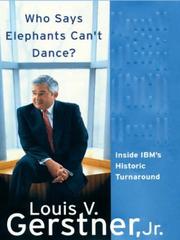
Who Says Elephants Can't Dance?
Insider account by the CEO who ran IBM's 1990s turnaround.
Summary
Gerstner ran IBM from 1993, when it was expected to be broken up after losing eight billion dollars in a year, until 2002. His account covers the decision to keep the company whole, the shift from hardware to services and middleware, the pricing change on mainframes, and the cultural change he attempted.
The central strategic decision was refusing to split IBM into independent units, which was the plan he inherited. Gerstner argued that IBM's only remaining advantage was its ability to integrate complex technology for large customers, and that this advantage existed only if the company stayed whole. From that followed the build-out of IBM Global Services, the decision to support competitors' products in its services work, the adoption of open standards and later of Linux, and the cut in mainframe prices that traded margin for the installed base that everything else depended on.
The cultural material is the second half, and Gerstner is blunt that culture was not a soft supporting factor but the thing that determined whether any strategy could execute. He describes the internal habits he attacked: the veto culture in which any unit could block a decision, the contention system, the presentation-driven meeting, and the compensation structure that paid people for their unit rather than for the company. The book is a chief executive memoir and it is self-serving in the usual ways, giving little credit to predecessors who had begun some of these shifts and to the mainframe revenue that funded the transition. It also stops in 2002, before the strategy Gerstner built ran out.
Key takeaways 7
- IBM's only durable advantage was integrating complex technology for large customers, and that advantage required keeping the company whole rather than splitting it.
- Cutting mainframe prices sharply traded near-term margin for retention of the installed base on which every other IBM business depended.
- Services became the growth engine only because IBM agreed to service competitors' hardware, which internal constituencies resisted.
- Culture is not one element of the game, it is the mechanism through which strategy either executes or does not.
- Large company decision processes fail when any unit can veto, because that converts every decision into a negotiation among people protecting their own results.
- Compensation tied to business unit performance guarantees that units will not cooperate, whatever the stated strategy says.
- A turnaround should begin with cash, cost and customer focus, and vision statements should come after the company can pay for them.
Who should read it
Executives leading a large-company turnaround or a shift from product to services, who want a first-hand account of the decisions and the cultural obstacles.
Where it sits in the reference 4
Who recommended it 1
Similar books 6
Chosen by shared topics, the entries that hold them, and the people who recommended both.