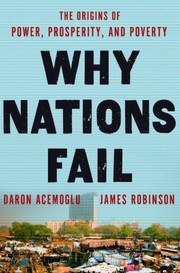
Why Nations Fail
Extractive versus inclusive institutions as the driver of divergence.
Summary
Acemoglu and Robinson argue that differences in national prosperity are explained by political and economic institutions rather than by geography, culture or the ignorance of leaders. They divide institutions into inclusive, which secure property rights, enforce contracts, permit entry and distribute political power broadly, and extractive, which concentrate power and extract resources from the population for the benefit of a narrow group.
Their mechanism is that inclusive economic institutions require inclusive political institutions to sustain them, because a narrow elite will always eventually change the economic rules in its favour. They also argue that extractive institutions can produce growth for a period, using the Soviet Union and contemporary China as examples, but cannot sustain it because sustained growth requires creative destruction, and creative destruction threatens the incumbent elite's position.
The evidence is comparative and historical, drawing on the divergence between North and South Korea, between Nogales in Arizona and Nogales in Sonora, on the different colonial institutions established in North and South America, on the Glorious Revolution in England, and on many African and Latin American cases. Their concept of critical junctures, in which existing institutional differences produce divergent responses to a common shock, explains why small initial differences compound.
The book argues directly against Diamond's geographic thesis and against cultural explanations. Critics argue that the inclusive and extractive categories are too broad to be useful, that the framework cannot explain China's sustained growth, that causation between institutions and prosperity runs in both directions, and that the historical cases are selected. Acemoglu received the Nobel Prize in economics in 2024 partly for this work. The creative destruction argument is the sharpest part of the thesis.
Key takeaways 8
- National prosperity is determined by political and economic institutions rather than by geography, culture or the knowledge available to leaders.
- Inclusive institutions secure property rights, enforce contracts and permit entry, which allows people to invest in outcomes they will capture.
- Extractive institutions concentrate power and transfer resources to a narrow elite, which removes the incentive to invest and innovate.
- Inclusive economic institutions cannot survive without inclusive political institutions, because a narrow elite will eventually rewrite the economic rules.
- Extractive institutions can generate growth for a period by directing resources into productive uses, but cannot sustain it.
- Sustained growth requires creative destruction, which threatens the position of incumbent elites and is therefore blocked under extractive arrangements.
- Small institutional differences at critical junctures produce divergent responses to common shocks, which compound over centuries.
- Foreign aid and policy advice fail where the institutions are extractive, because the resources are captured by the same arrangements that caused the poverty.
Who should read it
Investors assessing country risk and readers wanting the institutional counterargument to geographic and cultural explanations of development.
Where it sits in the reference 2
Who recommended it 6 · 2 direct
Similar books 6
Chosen by shared topics, the entries that hold them, and the people who recommended both.