 C
Podcast · 5 episodes in the reference, 2022 to 2025
Capitalisn't
Published by University of Chicago Podcast Network
Episodes
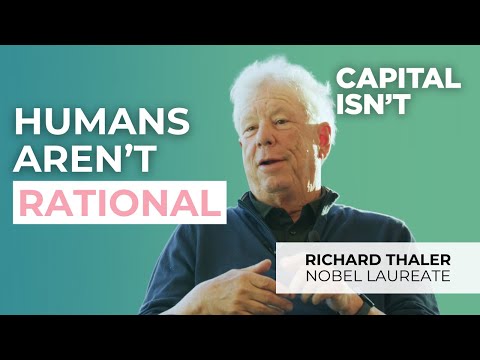 Nobel Economist Reveals Why Economic Models Keep Failing Us - ft. Richard Thaler | Capitalisn't | Richard H. Thaler | 30 October 2025 | 46 min | Standard economic theory informs how we think about business strategy and the economy and presumes that people are selfish, have well-defined preferences, and consistently make welfare-maximizing choices. In other words, we are rational. But what if that is not the case? Nobel Prize-winning economist Richard Thaler is out with an updated edition of his bestselling 1991 book, "The Winner's Curse: Paradoxes and Anomalies of Economic Life." In the new edition, he and his co-author Alex Imas (both professors at the University of Chicago Booth School of Business) reflect on the last thirty years of behavioral economics and how it makes sense of tensions between our psychological biases and impulses that make us less than fully rational in practice. Using a wealth of empirical evidence, the authors explore the behavioral anomalies that contradict the expectations of standard economic theory and explain a wide range of real-world examples from banking crises to social media addiction. Earlier this month, Thaler joined Bethany and Luigi for a sold-out Capitalisn’t recording in front of a live audience in Chicago to walk through the anomalies of human behavior that have endured from biblical times to the age of Big Tech. Thaler reflects on how views and the adoption of behavioral economics have changed over the last thirty years, both within academia and beyond (wonder why you can’t put down your phone? Silicon Valley has read Thaler). |
 Why Cliff Asness Believes Markets Are Getting Dumber | Eugene F. Fama | 12 June 2025 | 51 min | Are financial markets becoming less efficient? Famous investor Cliff Asness certainly thinks so. In his paper published last year, “ The Less-Efficient Market Hypothesis ,” Asness argues that social media and low interest rates, among other factors, have distorted market information so that stocks have become disconnected from their true values. This distortion has directed funds toward undeserving assets and firms and staved off necessary market corrections. Asness is the founder, managing principal, and chief investment officer at AQR Capital Management. He is an active researcher on various financial and investment topics and received an MBA and PhD in finance from the University of Chicago Booth School of Business. From her early days as a journalist reporting on Wall Street, Bethany recounts Asness as an outspoken, successful quant investor: one who invests based primarily on the fundamentals of the market rather than those of the firm. She also remembers him being “colloquial” and willing to be “experimental” with ideas. Asness’s recent paper continues that experimental style as he challenges the legacy of the efficient market hypothesis on which his PhD advisor, Nobel Prize laureate Eugene Fama, made his name, and which argues that asset prices reflect all available information, making it impossible to “beat” or outperform the market. |
| Is Private Credit In The Public Interest? with Jim Grant | James Grant | 25 April 2024 | 49 min | The meteoric rise of private credit over the last decade has raised concerns among banks about unfair competition and among regulators about risks to financial stability. Historically, regulated banks have provided most of the credit that finances businesses in the United States. However, since the 2008 financial crisis, banks have restricted their credit lines in response to new regulations. In their place has arisen private credit, which comprises direct (and mostly unregulated) lending, primarily from institutional investors. Estimates peg the current size of outstanding private credit loans in the U.S. at $1.7 trillion. Private credit loans aren't traceable, and there are incentives to lend to riskier borrowers in the absence of regulation. This could lead to catastrophic spillover effects in the event of a financial shock. This week, Bethany and Luigi sit down with Jim Grant, a longtime market and banking industry analyst, writer, and publisher of Grant's Interest Rate Observer , a twice-monthly journal of financial markets published since 1983. Together, they try to answer if private credit is in the public interest. Hosted by Simplecast, an AdsWizz company. See pcm.adswizz.com for information about our collection and use of personal data for advertising. |
| The Capitalisn't Of The U.S. COVID Response, With Bethany McLean | Bethany McLean | 19 October 2023 | 42 min | In her brand new book , "The Big Fail: What the Pandemic Revealed About Who America Protects and Who It Leaves Behind," Bethany and her co-author Joe Nocera argue that the COVID-19 pandemic was not simply a natural disaster but also a man-made one. Based on rigorous research and compelling storytelling, Bethany, who is renowned for her incisive reporting, reveals uncomfortable truths that have emerged from the pandemic about capitalism, inequality, and corporate power. In this one-on-one conversation with Luigi, she dissects the policies, decisions, and systemic structures that exacerbated the pandemic's fallout for the most vulnerable in society, shedding light on who benefited and who was left to fend for themselves. Hosted by Simplecast, an AdsWizz company. See pcm.adswizz.com for information about our collection and use of personal data for advertising. |
| Capitalism In Our Attention Economy With Albert Wenger | Albert Wenger | 15 September 2022 | 44 min | Albert Wenger is Managing Partner at Union Square Ventures, which has invested in some of today's most exciting technology companies. In his new book, “The World After Capital", he argues that capitalism cannot allocate all resources efficiently in the digital age – where the new shortage isn't capital, but rather, human attention. While economically incentivized activities will not go away, he says, we must make room for the things we cannot put a price on. He proposes increasing three freedoms: economic, informational, and psychological, to ensure the continuation of human knowledge production. His book is available free of charge at https://worldaftercapital.org/. Hosted by Simplecast, an AdsWizz company. See https://pcm.adswizz.com for information about our collection and use of personal data for advertising. |
CNobel Economist Reveals Why Economic Models Keep Failing Us - ft. Richard Thaler | Capitalisn'tRichard H. Thaler · 30 October 2025CWhy Cliff Asness Believes Markets Are Getting DumberEugene F. Fama · 12 June 2025CIs Private Credit In The Public Interest? with Jim GrantJames Grant · 25 April 2024CThe Capitalisn't Of The U.S. COVID Response, With Bethany McLeanBethany McLean · 19 October 2023CCapitalism In Our Attention Economy With Albert WengerAlbert Wenger · 15 September 2022