Updates

  1. Person pages list letters, writing, profiles and links as sortable tables with filters, and show each person's companies as links; Fund letters show each letter's description in its own column.
  2. Experts show a checked job title and a short description of each person; 30 more people have photographs.
  3. Every company, fund, university and publication the experts work for has a page listing the people there.
  4. Fund letters show each letter's thesis and filter by it; 225 person pages list the essays, columns and newsletter issues the person wrote.
  5. Person pages list every essay and newsletter issue a person wrote, and their own books as a table in List view.
  6. Recommends shows the five largest kinds of book and the rest under More; browse pictures load sooner.
  7. Podcasts and talks link the original episode, filter by Audio and video or Press, and list each publisher once.
  8. Pages are wider, Recommends has List and Grid, and a filter clicked again turns off.
  9. Book cards sit in a ruled grid with Open Library and Goodreads links and each book's one-line note.
  10. Funds is now Investors; each investor's styles are buttons that filter the table.
  11. Podcasts and talks on a person's page filter by year and publisher and show as a list or a grid of pictures.
  12. Quotes show only people's own words: 472 summaries written by list sites are gone.
  13. Country pages open from Browse again, and every link on the shelf lands on a page.
  14. Subject and person pages show their sections as tabs, and each book appears once on a person's page.
  15. Book cards show the quote, who said it and the source; grids show five cards to a row.
  16. On a phone, a menu holds the sections, search, Updates, Feedback and dark mode.
  17. Feedback takes a screenshot of the page with no browser prompt, opens a screenshot full size when you click it, and clears itself once sent.
  18. Book cards are centred, search names the topic each book sits in, and any text cut short shows whole on hover.
  19. Search groups its results by kind: people, companies, geographies, subjects, topics, books, funds, fund letters and papers.
  20. The Books table lists who recommended each book by name, and the browser tab names the section you are in.
  21. Feedback can take a screenshot of the page, or one you paste or choose, and opens in the corner beside Updates.
  22. Each rail button reopens its section where you left it, and Browse, Table and People show on every book and subject page.
  23. Filters grey out choices that hold nothing instead of hiding them, and Books › People filters by authors or recommenders.
  24. Feedback takes a subject line and up to three screenshots.
  25. Biographies are grouped by the person they are about: 41 new pages, from Abraham Lincoln to Lee Kuan Yew.
  26. Sport splits into 23 sports, and Religion into one topic per faith.
  27. Book lists show as cards: the cover, one recommendation quote and every recommender by name.
  28. Seventeen subjects that had two or three pages under different names now have one page each.
  29. Every page lists its Experts as authors and recommenders, with a link to them on the Experts tab.
  30. Economics, Financial history, Financial panics and Accounting are subjects of their own, with one page per financial crisis.
  31. Book, person and subject pages open inside the app, so the tabs stay in view.
  32. 996 more book covers, and photographs or logos for 227 more people and companies.
  33. Books › Browse shows every subject as cards, and the rail holds Fund letters, Papers, Experts, Books and Funds.
  34. Every topic over 150 books splits into narrower topics, each with a page of its own.

Send feedback

What is it?
Screenshots, up to 3 (optional)
or paste one with Ctrl+V

We use your email only to reply to you.

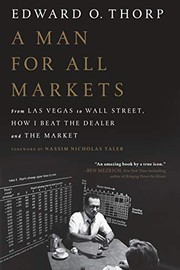
A Man for All Markets

A Man for All Markets

Edward O. Thorp
2017
T1 406 pages · about 6h 46m to read Open Librarygoodreads

Thorp applied Kelly to blackjack, then to convertible arbitrage.

Summary

Thorp's memoir covers a career in which he solved blackjack mathematically, wrote the first proof that the game could be beaten, tested it in Nevada casinos, then applied the same approach to warrant and convertible pricing and ran one of the first market-neutral hedge funds.

The intellectual content is the transfer of method. Thorp's blackjack work established that a small quantifiable edge combined with correct bet sizing produces reliable growth, and the Kelly criterion supplied the sizing rule. He then applied the same structure to securities: identify a mispricing between related instruments, hedge out the market exposure, size positions by edge, and repeat. With Kassouf he worked out warrant pricing before Black and Scholes published, and he was using a version of the option formula in trading before the paper appeared. Princeton Newport Partners ran from 1969 to 1988 with positive returns in every year.

The personal material includes his conclusion in the early 1990s, from examining the reported returns, that Bernard Madoff's operation could not be genuine, years before the collapse. He also covers the prosecution that closed Princeton Newport, in which the firm's partners were charged in a case connected to Milken and Drexel and the convictions were subsequently overturned.

The book is a memoir and the investment method is described rather than taught. Readers wanting the technique should read Beat the Market. Its value is the demonstration that the same analytical structure applies to games and to markets, and the first-hand account of how a quantitative edge is found and sized.

Key takeaways 7

  1. A small quantifiable edge combined with correct position sizing produces reliable growth, and the sizing rule matters as much as the edge.
  2. The same analytical structure applies to blackjack and to securities: find a measurable mispricing, hedge the exposure you are not paid for, and size by edge.
  3. Thorp derived a working option pricing method before Black and Scholes published, and used it in trading rather than publishing it.
  4. Market-neutral hedging removes the exposure an investor has no advantage in, which is what allows a small edge to be repeated at scale.
  5. Madoff's reported return series was inconsistent with any real trading strategy, and this was determinable from the numbers alone years before the collapse.
  6. Casinos and markets both respond to a demonstrated edge by changing the conditions, so any edge has a finite life and must be replaced.
  7. Independent verification of any claimed track record is possible from the reported data itself, and most investors never attempt it.

Who should read it

Investors interested in how a quantifiable edge is identified, hedged and sized, told first-hand by the person who did it in two different domains.

About Edward O. Thorp

Mathematician; founder, Princeton/Newport Partners 1969-1988 and Ridgeline Partners 1994-2002

Turned the Kelly criterion and warrant-pricing math into the first quantitative hedge fund, and his books are primary sources for both card counting and convertible arbitrage.

Ridgeline Partners, Princeton/Newport Partners

Similar books 6

Chosen by shared topics, the entries that hold them, and the people who recommended both.
Edward O. Thorp, Sheen T. Kassouf · 1967

A method to price warrants and convertibles and hedge them against the stock.

Edward O. Thorp, Leonard C. MacLean, William T. Ziemba · 2010

Edited volume of collected papers.

Recommended by: Nassim Nicholas Taleb
Gregory Zuckerman · 2019

How Jim Simons's Renaissance used maths and data to earn the best returns on record.

Recommended by: Andrew Wilkinson
Edward O. Thorp · 1962

The first proven way to beat blackjack, by counting the cards left in the deck.
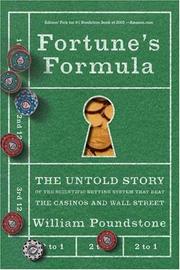
William Poundstone · 2005

The Kelly criterion for sizing bets, from Bell Labs to casinos and hedge funds.

Recommended by: Mohnish Pabrai

Marcos López de Prado · 2018

Why standard machine learning fails on market data, and how to avoid false backtests.

Where it sits in the reference 4

Investors
Portfolio & risk
Investment styles
Mental models

Topics

Biography and MemoirInvestingInvestors, Traders and GamblersQuants