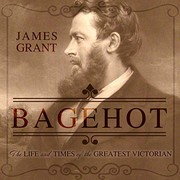
Bagehot: The Life and Times of the Greatest Victorian
A biography of Walter Bagehot, banker, Economist editor and author of Lombard Street.
title listed on grantspub.com books page
Summary
Grant, the financial writer and publisher of Grant's Interest Rate Observer, wrote a biography of Walter Bagehot, the banker, editor of The Economist and author of Lombard Street.
The biographical material covers Bagehot's family banking background, his marriage into the family that owned The Economist, his editorship, his political writing including The English Constitution, and his repeated unsuccessful attempts to enter Parliament.
The financial content is what Grant cares about. Bagehot's Lombard Street, published in 1873 after the Overend Gurney failure of 1866, set out the doctrine that in a panic the central bank should lend freely, at a high rate of interest, against good collateral. The rule has three parts that are frequently misquoted: freely, so that the panic is stopped; at a penalty rate, so that the facility is used only in genuine need and is repaid promptly; and against collateral that would be good in normal times, so that the central bank supports illiquid but solvent institutions rather than insolvent ones. Grant explains the context: the Bank of England had no legal obligation to act as lender of last resort and its directors disputed that it should, and Bagehot's contribution was to describe what the Bank was already doing and to argue it should acknowledge and formalise it.
Grant also examines Bagehot's inconsistencies, his commercial interests, his views on democracy which were unattractive, and his errors as a forecaster.
The book is written by an admirer with a strong view about modern central banking, and Grant's argument that current practice has abandoned the penalty rate and the good collateral requirement is present throughout. Readers should note the frame. The biography is well researched and Grant writes unusually well.
Key takeaways 7
- Bagehot's rule requires lending freely, at a penalty rate, against collateral that would be good in normal times.
- The penalty rate exists so that the facility is used only in genuine need and is repaid as soon as conditions permit.
- The good collateral requirement distinguishes support for illiquid institutions from support for insolvent ones.
- The Bank of England had no legal obligation to act as lender of last resort and its directors disputed that it should.
- Bagehot described what the Bank was already doing and argued it should acknowledge the responsibility publicly.
- A central bank that denies it will act in a crisis makes the crisis worse, because uncertainty about support increases the panic.
- Modern practice has largely abandoned the penalty rate and relaxed the collateral standard, which is Grant's central criticism.
Who should read it
Investors and anyone thinking about central banking who wants the origin of the lender of last resort doctrine and an argument that current practice departs from it.
About James Grant
Founder and editor, Grant's Interest Rate Observer (since 1983); financial historian and biographer
Grant's Interest Rate Observer is a primary source other investors read and quote, and Money of the Mind is a standard credit history.
Similar books 6
Chosen by shared topics, the entries that hold them, and the people who recommended both.
The Fed chair's memoir of his career at Treasury and the Fed, and beating inflation.
Recommended by: Michael Bloomberg, Ray Dalio, Warren Buffett
How American monetary policy changed from the 1950s through quantitative easing.
The Fed from 1913 to 1951, told from its own minutes and internal memos.
How the Federal Reserve was argued into existence, from the 1907 panic to 1913.
Recommended by: Seth Klarman
How the London money market worked, and why a central bank lends freely in a panic.
“The good times too of high price almost always engender much fraud,” wrote Walter Bagehot in Lombard Street: A Description of the Money Market (1877).” — Jeremy Grantham
Source: Valuing AI: Extreme Bubble, New Golden Era - or Both?, page 13
Recommended by: Jeremy Grantham
How American lending standards loosen in long cycles as the memory of losses fades.
“And right next to him I’d put Peter Bernstein (Against the Gods, The Power of Gold) and James Grant (Money of the Mind), both enormously gifted writers and friends of mine.” — John C. Bogle
Source: The Joy of Writing — Books, Ideas, Advocacy, and Idealism, page 3
Recommended by: John C. Bogle, Mohnish Pabrai, Seth Klarman and 1 other