Updates

  1. Person pages list letters, writing, profiles and links as sortable tables with filters, and show each person's companies as links; Fund letters show each letter's description in its own column.
  2. Experts show a checked job title and a short description of each person; 30 more people have photographs.
  3. Every company, fund, university and publication the experts work for has a page listing the people there.
  4. Fund letters show each letter's thesis and filter by it; 225 person pages list the essays, columns and newsletter issues the person wrote.
  5. Person pages list every essay and newsletter issue a person wrote, and their own books as a table in List view.
  6. Recommends shows the five largest kinds of book and the rest under More; browse pictures load sooner.
  7. Podcasts and talks link the original episode, filter by Audio and video or Press, and list each publisher once.
  8. Pages are wider, Recommends has List and Grid, and a filter clicked again turns off.
  9. Book cards sit in a ruled grid with Open Library and Goodreads links and each book's one-line note.
  10. Funds is now Investors; each investor's styles are buttons that filter the table.
  11. Podcasts and talks on a person's page filter by year and publisher and show as a list or a grid of pictures.
  12. Quotes show only people's own words: 472 summaries written by list sites are gone.
  13. Country pages open from Browse again, and every link on the shelf lands on a page.
  14. Subject and person pages show their sections as tabs, and each book appears once on a person's page.
  15. Book cards show the quote, who said it and the source; grids show five cards to a row.
  16. On a phone, a menu holds the sections, search, Updates, Feedback and dark mode.
  17. Feedback takes a screenshot of the page with no browser prompt, opens a screenshot full size when you click it, and clears itself once sent.
  18. Book cards are centred, search names the topic each book sits in, and any text cut short shows whole on hover.
  19. Search groups its results by kind: people, companies, geographies, subjects, topics, books, funds, fund letters and papers.
  20. The Books table lists who recommended each book by name, and the browser tab names the section you are in.
  21. Feedback can take a screenshot of the page, or one you paste or choose, and opens in the corner beside Updates.
  22. Each rail button reopens its section where you left it, and Browse, Table and People show on every book and subject page.
  23. Filters grey out choices that hold nothing instead of hiding them, and Books › People filters by authors or recommenders.
  24. Feedback takes a subject line and up to three screenshots.
  25. Biographies are grouped by the person they are about: 41 new pages, from Abraham Lincoln to Lee Kuan Yew.
  26. Sport splits into 23 sports, and Religion into one topic per faith.
  27. Book lists show as cards: the cover, one recommendation quote and every recommender by name.
  28. Seventeen subjects that had two or three pages under different names now have one page each.
  29. Every page lists its Experts as authors and recommenders, with a link to them on the Experts tab.
  30. Economics, Financial history, Financial panics and Accounting are subjects of their own, with one page per financial crisis.
  31. Book, person and subject pages open inside the app, so the tabs stay in view.
  32. 996 more book covers, and photographs or logos for 227 more people and companies.
  33. Books › Browse shows every subject as cards, and the rail holds Fund letters, Papers, Experts, Books and Funds.
  34. Every topic over 150 books splits into narrower topics, each with a page of its own.

Send feedback

What is it?
Screenshots, up to 3 (optional)
or paste one with Ctrl+V

We use your email only to reply to you.

Breaking Twitter

Breaking Twitter

Fast narrative of the takeover and the layoffs.

Summary

Mezrich reconstructs Elon Musk's acquisition of Twitter in 2022 and the months that followed, focusing on the internal experience of employees during the takeover, the mass layoffs and the reorganisation.

The narrative covers the stake accumulation and the offer, Musk's attempt to withdraw over the bot count dispute, the Delaware litigation that forced completion, the arrival at headquarters, the dismissal of the executive team, the cuts that removed roughly three quarters of staff, the ultimatum email requiring employees to commit to what Musk called hardcore work, the paid verification launch and its immediate abuse, the advertiser withdrawal, and the infrastructure decisions including the datacentre consolidation.

Mezrich writes narrative nonfiction with reconstructed dialogue, internal thoughts attributed to subjects, and scenes he did not witness. He has used this method since The Accidental Billionaires and it has drawn consistent criticism for the difficulty of separating what is documented from what is dramatised. Readers should treat specific scenes as unverified and the general sequence of events, which is well established from contemporaneous reporting, as reliable.

The book does not attempt business analysis. It says little about Twitter's pre-acquisition economics, which were poor, about why the advertising model underperformed relative to other social platforms, or about whether the cost reductions were justified by the revenue base. Anyone wanting to understand the transaction as a financial event, including the debt structure and its consequences, will need other sources. The account is also written from a moment when outcomes were unresolved.

Key takeaways 7

  1. Musk was contractually forced to complete an acquisition he attempted to abandon, because the merger agreement contained no financing or diligence outs.
  2. Roughly three quarters of Twitter's staff left or were dismissed within months without the service failing immediately.
  3. Paid verification launched without a mechanism to prevent impersonation, and the resulting abuse caused immediate advertiser damage.
  4. Advertisers withdrew primarily over brand safety and unpredictability rather than over any single policy decision.
  5. The acquisition debt was placed on the company itself, which turned an unprofitable business into one with large interest obligations.
  6. Institutional knowledge concentrated in small numbers of engineers was the binding constraint on how fast headcount could be cut.
  7. Reconstructed dialogue and attributed internal thoughts make this account unsuitable as a source for specific claims.

Who should read it

Readers wanting a narrative account of the takeover's internal experience, with the caveat that the method dramatises and the financial analysis is absent.

About Ben Mezrich

American author of dramatised nonfiction about card counting, Facebook's founding, the Winklevoss bitcoin position and the GameStop squeeze.

The books reconstruct financial episodes scene by scene from participant interviews, which is why several became films and why they reach readers who never open a market history. Read them as accounts told from one side, with dialogue and detail reconstructed rather than documented.

Similar books 6

Chosen by shared topics, the entries that hold them, and the people who recommended both.

Kate Conger, Ryan Mac · 2024

How Elon Musk's takeover wrecked Twitter.

Kurt Wagner · 2024

Twitter under Jack Dorsey's second spell as chief, through its sale to Elon Musk.

Zoë Schiffer · 2024

Elon Musk's takeover of Twitter, told through the employees who lived through it.
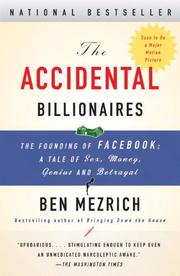
Ben Mezrich · 2009

Dramatised founding story; source for The Social Network.

Jean Burgess, Nancy K. Baym · 2020

Scholarly account of the product and its user culture.

Walter Isaacson · 2023

Two years shadowing Musk, across SpaceX, Tesla, Neuralink and the buying of Twitter.

Where it sits in the reference 3

Journalists
Companies
Biographies

Topics

Company HistoriesTechnology and ComputingTech company stories