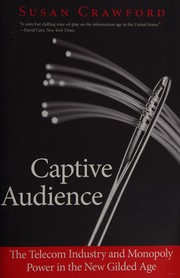
Captive Audience: The Telecom Industry and Monopoly Power in the New Gilded Age
How government decisions and monopolies left US internet access slow and costly.
Built around the Comcast-NBCUniversal deal and broadband monopoly.
Summary
Crawford, a telecommunications policy expert, visiting professor at Harvard Law School and fellow at the Roosevelt Institute, explains why Americans pay much more for high-speed internet access and get much less. Ten years before she wrote, the United States led the internet revolution, with some of the fastest speeds and lowest prices for broadband in the world, and seemed set to lead the knowledge economy.
That advantage almost disappeared, she argues, because of a series of government decisions and the monopolies they allowed, which let dozens of countries, including Japan and South Korea, pass the United States in both speed and price. Using the 2011 merger of Comcast and NBC Universal as her lens, Crawford examines how the country created its largest monopoly since the break-up of Standard Oil a century earlier, and how telecommunications monopolies affect consumers' daily lives and America's economic standing. She warns that the decline deprives people of services they need to compete for jobs and threatens the country's economic future.
Key takeaways 4
- American broadband went from among the cheapest and fastest in the world to lagging Japan and South Korea.
- Government decisions allowed telecommunications monopolies to form.
- The 2011 Comcast and NBC Universal merger created the largest monopoly since Standard Oil.
- Monopoly control of broadband raises prices and lowers service for consumers.
Who should read it
Investors in telecoms and media who want the case that American broadband is a monopoly market.
Similar books 6
Chosen by shared topics, the entries that hold them, and the people who recommended both.
Why America lags in fibre-optic broadband, and the case against the cable incumbents.
Every US information industry moved from an open era to control by one firm.
Recommended by: David Perell, Patrick Collison, Andrew Chen
How 1980s changes turned the US patent system from aid to obstacle for innovation.
Evidence that outside drugs and chemicals, patents fail to work as property.
How licensing in place of sale strips buyers of control over what they paid for.