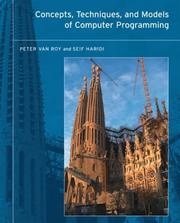
Concepts, Techniques, and Models of Computer Programming
Programming as one discipline, built up from a small kernel language.
Summary
Peter Van Roy and Seif Haridi treat programming as one discipline and argue that the boundaries between paradigms are artificial. They start from a small kernel language with a few concepts, show how to write and reason about programs in it, then add concepts one at a time to overcome each limit. This produces more than twenty computation models, all subsets of the multiparadigm language Oz: functional and logic programming, component-based and object-oriented programming, and concurrent programming with dataflow, streams, lazy execution, message passing and shared state, plus graphical interfaces, distributed and constraint programming.
One third of the book covers concurrency, including declarative concurrency, which avoids race conditions. It shows at least four ways to do data abstraction, places Erlang, Haskell, Java and Prolog within the framework, and gives a simple formal semantics for predicting behaviour, running time and memory use. More than 1,000 programs run on the Mozart Programming System. It appeared in 2004 for courses from second year to graduate level; the authors write that teaching one model, such as object-oriented Java, has no scientific basis.
Key takeaways 4
- Programming paradigms are sets of concepts, and two paradigms often differ by a single concept.
- Declarative concurrency gives concurrent programs without race conditions, and map and fold become concurrency patterns.
- Concurrent components that communicate by asynchronous messages are the right default structure for programs.
- There are at least four ways to do data abstraction, each with its own trade-offs.
Who should read it
Programmers and computer science students who know one language and want a single framework that explains how all the major paradigms relate.
Who recommended it 1 · 1 direct
Similar books 6
Chosen by shared topics, the entries that hold them, and the people who recommended both.
How non-programmers write their own software: end-user computing.
Recommended by: Patrick Collison
Advanced work on type systems and how they capture programs' run-time behaviour.
Recommended by: Patrick Collison
Apple's programming manuals for writing Macintosh software.
Recommended by: Patrick Collison
A reference on cryptography for programmers, with code in C.
Recommended by: Patrick Collison
Tips and tools for using BSD Unix operating systems.
Recommended by: Patrick Collison
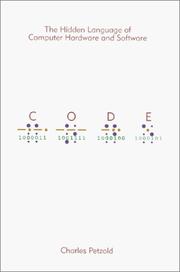
How computers work, built up from flashlights, codes and switches.
“Masterpiece of clear explanation! How to make a computer from scratch. Basics of electricity, 1/0 AND/OR switches, boolean algebra, how physical switches can make an adding machine, bytes and ASCII text, memory, CPU, and so on, up to a working computer. Each chapter building perfectly on the previous. If you’re interested in learning computers from scratch, this is the definitive book for it. (I rate this book a perfect 10 for what it is, but only giving an 8 here, because it’s not for everyone.)” — Derek Sivers
Source: Derek Sivers book notes (primary, rated list) · Rating: 8/10
Recommended by: Derek Sivers, Patrick Collison