Updates

  1. Person pages list letters, writing, profiles and links as sortable tables with filters, and show each person's companies as links; Fund letters show each letter's description in its own column.
  2. Experts show a checked job title and a short description of each person; 30 more people have photographs.
  3. Every company, fund, university and publication the experts work for has a page listing the people there.
  4. Fund letters show each letter's thesis and filter by it; 225 person pages list the essays, columns and newsletter issues the person wrote.
  5. Person pages list every essay and newsletter issue a person wrote, and their own books as a table in List view.
  6. Recommends shows the five largest kinds of book and the rest under More; browse pictures load sooner.
  7. Podcasts and talks link the original episode, filter by Audio and video or Press, and list each publisher once.
  8. Pages are wider, Recommends has List and Grid, and a filter clicked again turns off.
  9. Book cards sit in a ruled grid with Open Library and Goodreads links and each book's one-line note.
  10. Funds is now Investors; each investor's styles are buttons that filter the table.
  11. Podcasts and talks on a person's page filter by year and publisher and show as a list or a grid of pictures.
  12. Quotes show only people's own words: 472 summaries written by list sites are gone.
  13. Country pages open from Browse again, and every link on the shelf lands on a page.
  14. Subject and person pages show their sections as tabs, and each book appears once on a person's page.
  15. Book cards show the quote, who said it and the source; grids show five cards to a row.
  16. On a phone, a menu holds the sections, search, Updates, Feedback and dark mode.
  17. Feedback takes a screenshot of the page with no browser prompt, opens a screenshot full size when you click it, and clears itself once sent.
  18. Book cards are centred, search names the topic each book sits in, and any text cut short shows whole on hover.
  19. Search groups its results by kind: people, companies, geographies, subjects, topics, books, funds, fund letters and papers.
  20. The Books table lists who recommended each book by name, and the browser tab names the section you are in.
  21. Feedback can take a screenshot of the page, or one you paste or choose, and opens in the corner beside Updates.
  22. Each rail button reopens its section where you left it, and Browse, Table and People show on every book and subject page.
  23. Filters grey out choices that hold nothing instead of hiding them, and Books › People filters by authors or recommenders.
  24. Feedback takes a subject line and up to three screenshots.
  25. Biographies are grouped by the person they are about: 41 new pages, from Abraham Lincoln to Lee Kuan Yew.
  26. Sport splits into 23 sports, and Religion into one topic per faith.
  27. Book lists show as cards: the cover, one recommendation quote and every recommender by name.
  28. Seventeen subjects that had two or three pages under different names now have one page each.
  29. Every page lists its Experts as authors and recommenders, with a link to them on the Experts tab.
  30. Economics, Financial history, Financial panics and Accounting are subjects of their own, with one page per financial crisis.
  31. Book, person and subject pages open inside the app, so the tabs stay in view.
  32. 996 more book covers, and photographs or logos for 227 more people and companies.
  33. Books › Browse shows every subject as cards, and the rail holds Fund letters, Papers, Experts, Books and Funds.
  34. Every topic over 150 books splits into narrower topics, each with a page of its own.

Send feedback

What is it?
Screenshots, up to 3 (optional)
or paste one with Ctrl+V

We use your email only to reply to you.

Distressed Securities: Analyzing and Evaluat

Distressed Securities: Analyzing and Evaluating Market Potential and Investment Risk

Edward I. Altman
1991
T2 234 pages · about 3h 54m to read Open Librarygoodreads

Summary

Altman wrote this as a practitioner and academic treatment of the distressed securities market as it existed after the leveraged buyout period, covering the size and composition of the market, the analytical methods for valuing defaulted debt, and the empirical evidence on returns.

The analytical content covers his bankruptcy prediction work, particularly the Z-score model and its variants, applied to identifying candidates before default; the estimation of recovery rates by seniority, collateral and industry; the mechanics of Chapter 11 and the determination of which claim class receives the reorganised equity; and the construction of distressed debt indices and the measurement of returns to the asset class.

His empirical findings include that returns to distressed debt investing have been attractive but are concentrated in the periods immediately following default waves, that recovery rates vary systematically and predictably by seniority and industry, and that the market's size and liquidity had grown enough by the early 1990s to constitute an asset class rather than a specialist activity.

The reference has not verified the specific data in this 1991 volume. The market has changed fundamentally since: it has institutionalised, participants are far larger, and the tactics now include loan-to-own strategies, liability management exercises and non-pro-rata transactions that did not exist. Altman's own later book with Hotchkiss, Corporate Financial Distress and Bankruptcy, covers the same material in updated editions and should be used instead for current practice.

Key takeaways 7

  1. Distressed debt returns are attractive as an asset class but are concentrated in periods immediately following default waves rather than earned steadily.
  2. Recovery rates vary systematically and predictably by seniority, collateral type and industry, which makes them estimable before default.
  3. Bankruptcy prediction models identify candidates before default, which allows positioning before forced sellers arrive.
  4. Industry asset specificity is a major determinant of recovery, because assets with few alternative uses recover less regardless of seniority.
  5. The claim class that receives the reorganised equity is the central analytical question, and identifying it correctly determines the return.
  6. The distressed market grew in the early 1990s to a size and liquidity that made it an asset class rather than a specialist activity.
  7. The reference has not verified this volume's specific data, and Altman's later work with Hotchkiss covers the material in updated form.

Who should read it

Credit investors who want Altman's early treatment of distressed securities, with his later book as the current reference.

About Edward I. Altman

Professor emeritus of finance at NYU Stern who created the Z-score model of bankruptcy prediction.

The Z-score gave credit analysts a published, testable formula for default probability from balance sheet ratios, and it is still the default screen in distressed work. Corporate Financial Distress and Bankruptcy sets out the mechanics of Chapter 11 and restructuring alongside the recovery and default statistics that distressed investors price against.

NYU Stern School of Business

Who recommended it 1 · 1 direct

Similar books 6

Chosen by shared topics, the entries that hold them, and the people who recommended both.
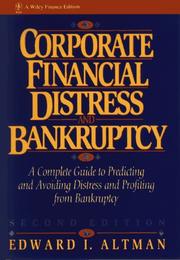
Edward I. Altman, Edith Hotchkiss · 1993

Predicting corporate failure with models like the Z-score, and how bankruptcy works.
Martin J. Whitman, Fernando Diz · 2009

Subtitled Principles and Technique.

Recommended by: Mohnish Pabrai
Hilary Rosenberg · 1992

The investors who bought the bonds of failing companies after the buyout era.

Recommended by: Mohnish Pabrai

Where it sits in the reference 2

Academics
Assets

Topics

Finance and MarketsInvesting