Updates

  1. Person pages list letters, writing, profiles and links as sortable tables with filters, and show each person's companies as links; Fund letters show each letter's description in its own column.
  2. Experts show a checked job title and a short description of each person; 30 more people have photographs.
  3. Every company, fund, university and publication the experts work for has a page listing the people there.
  4. Fund letters show each letter's thesis and filter by it; 225 person pages list the essays, columns and newsletter issues the person wrote.
  5. Person pages list every essay and newsletter issue a person wrote, and their own books as a table in List view.
  6. Recommends shows the five largest kinds of book and the rest under More; browse pictures load sooner.
  7. Podcasts and talks link the original episode, filter by Audio and video or Press, and list each publisher once.
  8. Pages are wider, Recommends has List and Grid, and a filter clicked again turns off.
  9. Book cards sit in a ruled grid with Open Library and Goodreads links and each book's one-line note.
  10. Funds is now Investors; each investor's styles are buttons that filter the table.
  11. Podcasts and talks on a person's page filter by year and publisher and show as a list or a grid of pictures.
  12. Quotes show only people's own words: 472 summaries written by list sites are gone.
  13. Country pages open from Browse again, and every link on the shelf lands on a page.
  14. Subject and person pages show their sections as tabs, and each book appears once on a person's page.
  15. Book cards show the quote, who said it and the source; grids show five cards to a row.
  16. On a phone, a menu holds the sections, search, Updates, Feedback and dark mode.
  17. Feedback takes a screenshot of the page with no browser prompt, opens a screenshot full size when you click it, and clears itself once sent.
  18. Book cards are centred, search names the topic each book sits in, and any text cut short shows whole on hover.
  19. Search groups its results by kind: people, companies, geographies, subjects, topics, books, funds, fund letters and papers.
  20. The Books table lists who recommended each book by name, and the browser tab names the section you are in.
  21. Feedback can take a screenshot of the page, or one you paste or choose, and opens in the corner beside Updates.
  22. Each rail button reopens its section where you left it, and Browse, Table and People show on every book and subject page.
  23. Filters grey out choices that hold nothing instead of hiding them, and Books › People filters by authors or recommenders.
  24. Feedback takes a subject line and up to three screenshots.
  25. Biographies are grouped by the person they are about: 41 new pages, from Abraham Lincoln to Lee Kuan Yew.
  26. Sport splits into 23 sports, and Religion into one topic per faith.
  27. Book lists show as cards: the cover, one recommendation quote and every recommender by name.
  28. Seventeen subjects that had two or three pages under different names now have one page each.
  29. Every page lists its Experts as authors and recommenders, with a link to them on the Experts tab.
  30. Economics, Financial history, Financial panics and Accounting are subjects of their own, with one page per financial crisis.
  31. Book, person and subject pages open inside the app, so the tabs stay in view.
  32. 996 more book covers, and photographs or logos for 227 more people and companies.
  33. Books › Browse shows every subject as cards, and the rail holds Fund letters, Papers, Experts, Books and Funds.
  34. Every topic over 150 books splits into narrower topics, each with a page of its own.

Send feedback

What is it?
Screenshots, up to 3 (optional)
or paste one with Ctrl+V

We use your email only to reply to you.

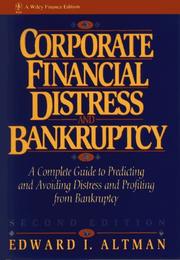
Corporate Financial Distress and Bankruptcy

Corporate Financial Distress and Bankruptcy

Edward I. Altman, Edith Hotchkiss
1993
T2 355 pages · about 5h 55m to read Open Librarygoodreads

The academic standard; source of the Z-score.

Summary

Altman, who created the Z-score bankruptcy prediction model in 1968, and Hotchkiss produced the standard reference on corporate distress. It covers prediction models, the legal process of bankruptcy, the market for distressed securities, recovery rates and the empirical evidence on outcomes.

The prediction material is the book's foundation. Altman's Z-score combines five financial ratios into a single discriminant score that separates firms likely to fail from those likely to survive, and the book covers its construction, its subsequent variants for private and non-manufacturing firms, its performance over decades, and competing models including hazard models and structural models based on option pricing.

The legal and empirical material covers the Chapter 11 process, the frequency and consequences of Chapter 22, meaning a second bankruptcy after emerging from a first, the direct and indirect costs of distress, the determinants of recovery rates by seniority and by industry, and the performance of distressed securities as an investment class. Altman's work on recovery rates being negatively correlated with default rates is important for credit modelling, since it means losses are worst exactly when defaults are most numerous.

The book is a reference work with extensive empirical tables. It has been revised across editions and readers should use a recent one, since bankruptcy practice, recovery data and the distressed market have all changed substantially. The prediction models remain in wide use and their limitations, particularly poor performance on financial firms and on companies with substantial intangible assets, are stated by the authors.

Key takeaways 7

  1. A small number of financial ratios combined in a discriminant model separate firms likely to fail from those likely to survive with useful accuracy.
  2. Recovery rates on defaulted debt are negatively correlated with default rates, which means credit losses are worst exactly when defaults are most numerous.
  3. A substantial share of firms emerging from Chapter 11 file again, which indicates many reorganisations resolve the balance sheet without addressing the business.
  4. Indirect costs of financial distress, including lost customers, supplier terms and departing staff, exceed the direct legal and advisory costs.
  5. Recovery rates vary systematically by seniority, by collateral and by industry, and industry asset specificity is a major determinant.
  6. Bankruptcy prediction models perform poorly on financial firms and on companies whose value is in intangible assets, which the ratios do not capture.
  7. Distressed securities have produced attractive returns as an asset class, and the returns are concentrated in periods immediately following default waves.

Who should read it

Credit analysts and distressed investors who need the standard reference on failure prediction, recovery rates and bankruptcy outcomes.

About Edward I. Altman

Professor emeritus of finance at NYU Stern who created the Z-score model of bankruptcy prediction.

The Z-score gave credit analysts a published, testable formula for default probability from balance sheet ratios, and it is still the default screen in distressed work. Corporate Financial Distress and Bankruptcy sets out the mechanics of Chapter 11 and restructuring alongside the recovery and default statistics that distressed investors price against.

NYU Stern School of Business

Similar books 6

Chosen by shared topics, the entries that hold them, and the people who recommended both.
Edward I. Altman · 1991

The distressed debt market after the buyout era, and how to analyse its securities.

Recommended by: Mohnish Pabrai
Stuart C. Gilson · 2001

Harvard case studies in bankruptcy and workout situations.

Martin J. Whitman, Fernando Diz · 2009

Subtitled Principles and Technique.

Recommended by: Mohnish Pabrai
Stephen G. Moyer · 2004

How to analyse and invest in troubled companies' debt: law, valuation and tactics.
Where it sits in the reference 2

Academics
Assets

Topics

Finance and MarketsInvestingReference WorksFinance, accounting and economics references