Updates

  1. Person pages list letters, writing, profiles and links as sortable tables with filters, and show each person's companies as links; Fund letters show each letter's description in its own column.
  2. Experts show a checked job title and a short description of each person; 30 more people have photographs.
  3. Every company, fund, university and publication the experts work for has a page listing the people there.
  4. Fund letters show each letter's thesis and filter by it; 225 person pages list the essays, columns and newsletter issues the person wrote.
  5. Person pages list every essay and newsletter issue a person wrote, and their own books as a table in List view.
  6. Recommends shows the five largest kinds of book and the rest under More; browse pictures load sooner.
  7. Podcasts and talks link the original episode, filter by Audio and video or Press, and list each publisher once.
  8. Pages are wider, Recommends has List and Grid, and a filter clicked again turns off.
  9. Book cards sit in a ruled grid with Open Library and Goodreads links and each book's one-line note.
  10. Funds is now Investors; each investor's styles are buttons that filter the table.
  11. Podcasts and talks on a person's page filter by year and publisher and show as a list or a grid of pictures.
  12. Quotes show only people's own words: 472 summaries written by list sites are gone.
  13. Country pages open from Browse again, and every link on the shelf lands on a page.
  14. Subject and person pages show their sections as tabs, and each book appears once on a person's page.
  15. Book cards show the quote, who said it and the source; grids show five cards to a row.
  16. On a phone, a menu holds the sections, search, Updates, Feedback and dark mode.
  17. Feedback takes a screenshot of the page with no browser prompt, opens a screenshot full size when you click it, and clears itself once sent.
  18. Book cards are centred, search names the topic each book sits in, and any text cut short shows whole on hover.
  19. Search groups its results by kind: people, companies, geographies, subjects, topics, books, funds, fund letters and papers.
  20. The Books table lists who recommended each book by name, and the browser tab names the section you are in.
  21. Feedback can take a screenshot of the page, or one you paste or choose, and opens in the corner beside Updates.
  22. Each rail button reopens its section where you left it, and Browse, Table and People show on every book and subject page.
  23. Filters grey out choices that hold nothing instead of hiding them, and Books › People filters by authors or recommenders.
  24. Feedback takes a subject line and up to three screenshots.
  25. Biographies are grouped by the person they are about: 41 new pages, from Abraham Lincoln to Lee Kuan Yew.
  26. Sport splits into 23 sports, and Religion into one topic per faith.
  27. Book lists show as cards: the cover, one recommendation quote and every recommender by name.
  28. Seventeen subjects that had two or three pages under different names now have one page each.
  29. Every page lists its Experts as authors and recommenders, with a link to them on the Experts tab.
  30. Economics, Financial history, Financial panics and Accounting are subjects of their own, with one page per financial crisis.
  31. Book, person and subject pages open inside the app, so the tabs stay in view.
  32. 996 more book covers, and photographs or logos for 227 more people and companies.
  33. Books › Browse shows every subject as cards, and the rail holds Fund letters, Papers, Experts, Books and Funds.
  34. Every topic over 150 books splits into narrower topics, each with a page of its own.

Send feedback

What is it?
Screenshots, up to 3 (optional)
or paste one with Ctrl+V

We use your email only to reply to you.

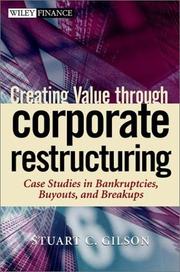
Creating Value Through Corporate Restructuri

Creating Value Through Corporate Restructuring

Stuart C. Gilson
2001
T3 528 pages · about 8h 48m to read Open Librarygoodreads

Harvard case studies in bankruptcy and workout situations.

Summary

Gilson, a Harvard Business School professor, assembled case studies of financially distressed and structurally underperforming companies and the transactions used to address them: Chapter 11 reorganisations, out-of-court debt exchanges, divestitures, spin-offs, carve-outs, tracking stock, asset sales and bankruptcy-driven acquisitions. Cases include Continental Airlines, Kmart, Flagstar, Humana, Sealed Air's leveraged recapitalisation, and the National Gypsum asbestos reorganisation.

The book's analytical contribution is treating restructuring as a set of transactions each with identifiable value sources and costs, rather than as crisis management. Gilson works through where value actually comes from in each: tax attributes and net operating loss carryforwards, the removal of cross-subsidies between businesses with different capital needs, improved incentive alignment when a divested unit's management holds equity in it, the discipline of debt in a recapitalisation, and the ability of Chapter 11 to reject leases and contracts. He is precise about the direct and indirect costs of bankruptcy and about how the choice between in-court and out-of-court restructuring depends on the number of creditor classes and on holdout problems.

The teaching notes and financial exhibits make it usable for building models. It is a casebook and requires work; it is not a narrative. The second edition updates some material. The legal environment has shifted since 2001, particularly in how creditor coalitions form and in the rise of liability management transactions, and readers should treat the bankruptcy procedure detail as requiring verification against current practice.

Key takeaways 7

  1. Restructuring transactions each have identifiable and separable value sources, and a manager should be able to name which one a proposed transaction is capturing.
  2. Spin-offs create value primarily by removing cross-subsidies between businesses with different capital requirements and by giving unit management equity in their own results.
  3. Out-of-court restructuring is cheaper than Chapter 11 but fails when creditor classes are numerous, because individual holdouts can extract value from a consensual deal.
  4. Chapter 11's power to reject leases and executory contracts is frequently the largest single source of value in a reorganisation.
  5. Net operating loss carryforwards are a real asset whose preservation shapes how a restructuring must be structured.
  6. The indirect costs of financial distress, meaning lost customers, suppliers demanding cash and departing employees, usually exceed the direct legal and advisory costs.
  7. A leveraged recapitalisation can create value by imposing debt service discipline on managers who would otherwise reinvest cash at low returns.

Who should read it

Investors, corporate finance teams and advisers who want a case-based treatment of where value comes from in each restructuring transaction type.

Similar books 6

Chosen by shared topics, the entries that hold them, and the people who recommended both.

Sujeet Indap, Max Frumes · 2021

Modern creditor-on-creditor warfare told as narrative.
Edward I. Altman, Edith Hotchkiss · 1993

Predicting corporate failure with models like the Z-score, and how bankruptcy works.

Martin J. Whitman, Fernando Diz · 2009

Subtitled Principles and Technique.

Recommended by: Mohnish Pabrai
Stephen G. Moyer · 2004

How to analyse and invest in troubled companies' debt: law, valuation and tactics.

Edward I. Altman · 1991

The distressed debt market after the buyout era, and how to analyse its securities.

Recommended by: Mohnish Pabrai

Where it sits in the reference 4

Assets
Investment styles
Investment styles
Business models

Topics

Finance and MarketsInvesting