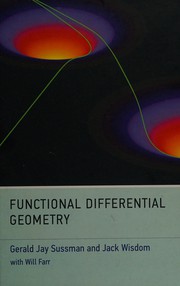
Functional Differential Geometry
The differential geometry needed for general relativity and quantum field theory.
Summary
Gerald Jay Sussman and his co-author explain the differential geometry needed for a deep understanding of general relativity or quantum field theory as taught at college level. They start from the problem that physics students must learn an idiomatic mathematical language at the same time as the content expressed in it, which the authors compare to reading Les Misérables while struggling with French grammar.
Their approach, used for many years in their classes at MIT, departs from the conventional one in several ways. It puts emphasis on developing the covariant derivative, and it avoids traditional index notation for tensors in favour of what the authors call a semantically richer language of vector fields and differential forms. The largest difference is the integration of computer programming into the explanations: by programming a computer to interpret a formula, students learn quickly whether the formula is correct, and as they improve their programs they improve their understanding.
Key takeaways 4
- Students struggle because they learn mathematical language and physics content at once.
- Vector fields and differential forms replace traditional index notation for tensors.
- Writing programs to evaluate formulas exposes errors and deepens understanding.
- The course builds toward general relativity and quantum field theory.
Who should read it
Physics and mathematics students preparing for general relativity who are comfortable with programming.
Who recommended it 1 · 1 direct
Similar books 6
Chosen by shared topics, the entries that hold them, and the people who recommended both.
A course in calculus and mathematical analysis.
Recommended by: Patrick Collison
A text on abstract algebra and how its areas connect.
Recommended by: Patrick Collison
Advanced work on type systems and how they capture programs' run-time behaviour.
Recommended by: Patrick Collison
The standard introduction to harmonic analysis for students.
Recommended by: Patrick Collison
A reference on cryptography for programmers, with code in C.
Recommended by: Patrick Collison
Recommended by: Patrick Collison, Eric Weinstein