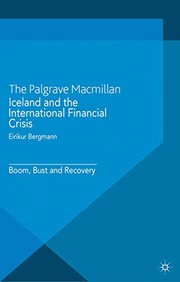
Iceland and the International Financial Crisis
Iceland's banking boom and collapse, read through its national identity and politics.
Political economy of the boom, the Icesave dispute and the aftermath.
Summary
Eirikur Bergmann is a political scientist, and he approaches Iceland's banking collapse through national identity and political culture rather than through banking economics. He traces a long-running Icelandic narrative of exceptionalism, from the sagas through the independence struggle with Denmark, the cod wars with Britain, and the country's position between Europe and America, and argues that this narrative shaped how Icelandic elites understood the banks' foreign expansion after privatisation in 2003.
The substantive account covers the privatisation of Landsbanki, Kaupthing and Glitnir into the hands of politically connected owners, the growth of the banking system to roughly ten times GDP, the funding shift from wholesale markets to internet retail deposits gathered in Britain and the Netherlands under the Icesave brand, and the collapse in October 2008. Bergmann gives particular attention to the Icesave dispute, the British use of anti-terrorism legislation to freeze Landsbanki assets, and the two referendums in which Icelandic voters rejected the repayment agreements.
The book is stronger on politics and rhetoric than on the banking mechanics; readers wanting the balance-sheet story should go to Jonsson and Sigurgeirsson or to Bibler. Bergmann's identity-based explanation is suggestive rather than demonstrated, and it is difficult to distinguish from an ordinary account of political capture. His treatment of the European Union accession question reflects the moment of writing and has been overtaken by events.
Key takeaways 7
- Iceland privatised its banks into politically connected ownership without building supervisory capacity to match.
- A banking system roughly ten times national output leaves the state unable to act as a credible lender of last resort in foreign currency.
- Icesave retail deposits looked like stable funding and behaved like wholesale funding once confidence broke.
- Bergmann argues that a national self-image of exceptional capability suppressed domestic criticism of the banks' expansion.
- Britain's use of anti-terrorism powers against Landsbanki converted a financial dispute into a nationalist political conflict inside Iceland.
- Icelandic voters rejected the Icesave settlements twice, which demonstrates that democratic ratification constrains cross-border bank resolution.
- Small states running large international banking sectors export risk that they cannot themselves absorb.
Who should read it
Readers interested in the political economy of small-state banking crises and in how national narratives affect regulatory behaviour.
Similar books 6
Chosen by shared topics, the entries that hold them, and the people who recommended both.
Studies of the blame, protest and rebuilding that followed Iceland's bank collapse.
How Iceland's three big banks collapsed, from the parliamentary inquiry's evidence.
How Iceland went bankrupt, reported by a Times journalist within a year.

How Iceland, Greece, Ireland, Germany and California each spent cheap credit.
“And if you just are curious and want a good “real life is better than fiction” kind of read, you can get that also from Boomerang.” — Brad Feld
Source: Book: Boomerang: Travels in the New Third World — Feld Thoughts
Recommended by: Brad Feld, Mohnish Pabrai, Alfred Lin and 1 other
How Iceland's banks grew and failed, by Kaupthing's former chief economist.
The investigator who built Iceland's market-manipulation cases against its banks.
Where it sits in the reference 2
Topics 4
As an Amazon Associate I earn from qualifying purchases.