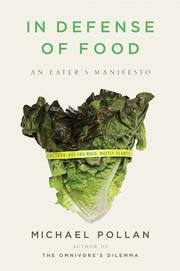
In Defense of Food
What to eat and how to think about health: eat food, not too much, mostly plants.
Summary
Michael Pollan's 2008 book, subtitled An Eater's Manifesto, grew out of his 2007 New York Times Magazine essay "Unhappy Meals" and answered readers of The Omnivore's Dilemma who asked what they should eat. It spent six weeks at number one on the New York Times nonfiction list. Its answer fits in seven words: "Eat food. Not too much. Mostly plants."
Pollan explores the relationship between nutritionism and the Western diet. He argues that nutritionism, as an ideology, has overcomplicated and damaged American eating habits, and that people should eat the kind of food their ancestors would recognise rather than focusing on nutrients; much of what Americans eat, he says, is not real food but "edible foodlike substances". Since scientists have not identified the full range of nutrients, he argues, nutrition science should not drive eating habits, and the more Americans focus on nutrition the less healthy they seem to become. He recommends spending more money and time on food and buying locally.
Key takeaways 4
- "Eat food. Not too much. Mostly plants."
- Focusing on nutrients rather than whole foods has made eating worse, not better.
- Much of the Western diet is processed foodlike substances.
- Eat what your ancestors would recognise, and spend more time and money on food.
Who should read it
General readers confused by nutrition advice who want a simple approach to eating well.
Who recommended it 1 · 1 direct
Similar books 6
Chosen by shared topics, the entries that hold them, and the people who recommended both.
A news anchor's panic attack on air leads him to meditation, and what it did for him.
Recommended by: Nat Eliason, Arianna Huffington, Peter Attia and 2 others
Radical life extension and what longer lifespans would do to markets.
Recommended by: Mohnish Pabrai, Peter Thiel
A guide to holistic health through yoga, Ayurveda and self-care.
Recommended by: Mohnish Pabrai
How parents can teach the values that keep a child's experiments from addiction.
Recommended by: Nir Eyal
Attention deficit disorder in adults and children, and how to manage it.
Recommended by: Andrew Wilkinson
What science shows about how meditation changes the mind, brain and body.
Recommended by: Peter Attia