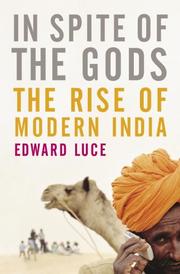
In Spite of the Gods
An introduction to modern India's rise and its many contradictions.
The political economy behind the growth story, by an FT Delhi bureau chief.
Summary
Luce, a journalist who covered India for many years, explains India's rise to global power and its contradictions. India was set to become the world's third largest economy within a generation, overtaking Japan, to pass China in population by 2032 and to have more English speakers than the United States by 2050. Yet its celebrated technology sector employed no more than one million of its 1.1 billion people, only 35 million held jobs formal enough to pay tax, and three-quarters of the population lived in extreme deprivation in 600,000 villages.
Amid these extremes India runs the world's largest experiment in representative democracy, largely successful despite corrupt bureaucracies. Luce argues that India rivals the United States differently from China: it has nothing like China's manufacturing capacity, and a poor public education system leaves most Indians illiterate and unskilled, yet its middle class produces ten times as many engineering students a year as the United States. American leaders have encouraged India's rise, admitting it to the nuclear energy club to balance China. Luce concludes that India's future is hers to lose.
Key takeaways 4
- India's technology boom employs a tiny share of its 1.1 billion people.
- Only about 35 million Indians hold formal jobs that pay tax.
- India lacks China's manufacturing base and a working public education system.
- Its democracy has largely succeeded despite deep corruption in the bureaucracy.
Who should read it
Investors in India who want a clear account of the political economy beneath the growth story.
Who recommended it 1 · 1 direct
Similar books 6
Chosen by shared topics, the entries that hold them, and the people who recommended both.
India's billionaires, crony capitalism, and the bad-loan crisis in its banks.
A memoir of India's economic reforms by a senior official who shaped them.
India's past, present and future through the ideas that have shaped it.
Recommended by: Mohnish Pabrai
Why India's present path will not make it a high-income country, and what would.
India's economy from independence to 2000, told alongside a P&G executive's career.
A polemic on the human cost of India's great dam projects.
Recommended by: Mohnish Pabrai