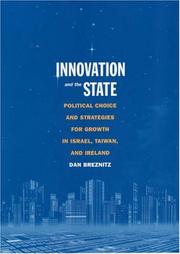
Innovation and the State
How Israel, Taiwan and Ireland each used the state to build IT industries.
Compares Israel, Taiwan and Ireland; the serious analysis behind Start-Up Nation.
Summary
Dan Breznitz compares how Israel, Taiwan and Ireland built information technology industries, and argues that all three states intervened heavily but in different ways, producing industries with different structures and different positions in the global production system. The comparison undermines both the claim that state intervention is unnecessary and the claim that there is one developmental state model.
Israel's state, in his account, funded research through the Office of the Chief Scientist and through defence spending, and produced a start-up industry oriented toward selling technology and companies to foreign acquirers rather than building large domestic firms. Taiwan's state built public research institutes, principally ITRI, that developed technology and spun it out to private firms, producing an industry specialised in manufacturing and process innovation with limited product branding. Ireland's state attracted multinational subsidiaries with tax and grants, producing large employment in operations but limited indigenous research capability, with a domestic software sector emerging partly in the shadow of the multinationals.
Breznitz's central concept is the fragmentation of production, which lets a country specialise in a stage of the innovation process rather than in a whole industry. He argues that each state chose, implicitly or explicitly, which stage to occupy. The book is academic, based on interviews and industry data, and it is careful about the limits of the comparison. Its weakness is that the outcomes it describes were still developing, and the Israeli and Taiwanese industries have since moved in directions the book anticipates only partly.
Key takeaways 7
- State intervention shaped all three technology industries, so the useful question is which form of intervention rather than whether to intervene.
- Fragmentation of global production lets a country specialise in one stage of innovation instead of building an entire industry.
- Israel's public research funding and defence procurement produced a start-up sector oriented toward acquisition rather than toward scale.
- Taiwan's public research institutes developed technology and transferred it to private firms, which built process capability rather than branded products.
- Ireland's tax-driven attraction of multinationals created employment without creating indigenous research capacity.
- The industrial structure a country ends with follows from the specific institutions the state built, not from generic openness or generic support.
- Breznitz argues that a state cannot choose its position in global production directly, but can choose which capabilities to fund and thereby constrain the outcome.
Who should read it
Investors and policymakers comparing national technology ecosystems who want a structural explanation for why start-up, contract-manufacturing and subsidiary models emerge in different places.
Similar books 6
Chosen by shared topics, the entries that hold them, and the people who recommended both.
How 1980s changes turned the US patent system from aid to obstacle for innovation.

Why Israel produces so many tech start-ups, from military service to immigration.
Recommended by: Balaji S. Srinivasan
Essays by consultants and executives on restructuring businesses for the internet.
Recommended by: Mohnish Pabrai

Digital costs near zero mean goods can be given away, which changes whole industries.
“During the month I read Chris Anderson’s excellent 2009 book “Free” and found in it a lot of sense about the way the business world is today and where it’s going – certainly more sense than I get from watching a Bloomberg scr” — Nick Train
Source: April 2016 Monthly Manager Report, page 2
Recommended by: Nick Train