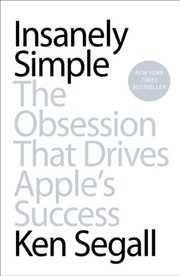
Insanely Simple
Simplicity as Apple's operating principle, from the adman who worked with Jobs.
Summary
Segall worked as an advertising creative director with Steve Jobs at NeXT and at Apple, and named the iMac. He argues that simplicity was Apple's operating principle rather than an aesthetic preference, and that maintaining it required constant enforcement against the natural tendency of organisations toward complexity.
His specific claims cover several areas. Small groups make better decisions than large ones, and Jobs removed people from meetings when he judged they had no reason to be present. Decisions should be made by the smallest number of people with the authority to make them, and approval chains destroy the work by requiring it to satisfy everyone. Product lines should be minimal, which Segall connects to the 1997 four-quadrant product grid. Marketing should present one idea rather than a list of features. Names should be simple and memorable, which he covers through the iMac naming.
His contrast case is Intel, where he also worked, and he uses the difference between the two companies' approval processes and product line complexity to make the argument concretely. He also covers the cost of simplicity, which is that it requires someone with authority to say no repeatedly and to accept the resulting conflict, and that organisations without such a person default to complexity.
The book is written by an advertising professional about advertising and brand decisions, so the operational and technical dimensions are absent. It is favourable to Jobs and Apple throughout. The observations about meeting size, approval chains and product line complexity are concrete enough to act on.
Key takeaways 8
- Simplicity requires constant enforcement against the natural tendency of organisations toward complexity rather than being achieved once.
- Small groups make better decisions, and people with no reason to be in a meeting should be removed from it.
- Approval chains destroy work by requiring it to satisfy everyone, which produces output nobody objects to and nobody wants.
- A minimal product line makes both the customer's choice and the company's execution simpler, which compounds across every function.
- Marketing should present one idea rather than a list of features, because a list communicates nothing that is remembered.
- Simplicity requires someone with authority to say no repeatedly and to accept the conflict this produces.
- Organisations without such a person default to complexity, since every individual has a reason to add something.
- The book covers brand and advertising decisions and does not address the operational or technical dimensions of the company.
Who should read it
Marketers and executives fighting organisational complexity who want specific practices from someone who observed them being enforced.
Who recommended it 3 · 2 direct
Similar books 6
Chosen by shared topics, the entries that hold them, and the people who recommended both.

Nokia's chairman on selling the phone unit to Microsoft and buying Alcatel-Lucent.
How Google hired and managed smart creatives, people who can't be told what to do.
Recommended by: Cynthia Johnson, Keith Rabois and 2 others
How corporate governance brought down Nortel Networks, the Canadian technology firm.
“You may understand why I say this if you read the recent book on Nortel’s bankruptcy ‘‘100 Days: The rush to judgment that killed Nortel’’, by James Bagnall.” — Prem Watsa
Source: Chairman's Letter to Shareholders 2013, page 6
Recommended by: Mohnish Pabrai, Prem Watsa

An eyewitness account of how Ford and the American car industry undid themselves.
Recommended by: Mohnish Pabrai

The story of the Walgreens drugstore chain and the American history around it.
Recommended by: Mohnish Pabrai
How Alan Mulally turned Ford around and saved it without bankruptcy.
Recommended by: Mohnish Pabrai