Updates

  1. Person pages list letters, writing, profiles and links as sortable tables with filters, and show each person's companies as links; Fund letters show each letter's description in its own column.
  2. Experts show a checked job title and a short description of each person; 30 more people have photographs.
  3. Every company, fund, university and publication the experts work for has a page listing the people there.
  4. Fund letters show each letter's thesis and filter by it; 225 person pages list the essays, columns and newsletter issues the person wrote.
  5. Person pages list every essay and newsletter issue a person wrote, and their own books as a table in List view.
  6. Recommends shows the five largest kinds of book and the rest under More; browse pictures load sooner.
  7. Podcasts and talks link the original episode, filter by Audio and video or Press, and list each publisher once.
  8. Pages are wider, Recommends has List and Grid, and a filter clicked again turns off.
  9. Book cards sit in a ruled grid with Open Library and Goodreads links and each book's one-line note.
  10. Funds is now Investors; each investor's styles are buttons that filter the table.
  11. Podcasts and talks on a person's page filter by year and publisher and show as a list or a grid of pictures.
  12. Quotes show only people's own words: 472 summaries written by list sites are gone.
  13. Country pages open from Browse again, and every link on the shelf lands on a page.
  14. Subject and person pages show their sections as tabs, and each book appears once on a person's page.
  15. Book cards show the quote, who said it and the source; grids show five cards to a row.
  16. On a phone, a menu holds the sections, search, Updates, Feedback and dark mode.
  17. Feedback takes a screenshot of the page with no browser prompt, opens a screenshot full size when you click it, and clears itself once sent.
  18. Book cards are centred, search names the topic each book sits in, and any text cut short shows whole on hover.
  19. Search groups its results by kind: people, companies, geographies, subjects, topics, books, funds, fund letters and papers.
  20. The Books table lists who recommended each book by name, and the browser tab names the section you are in.
  21. Feedback can take a screenshot of the page, or one you paste or choose, and opens in the corner beside Updates.
  22. Each rail button reopens its section where you left it, and Browse, Table and People show on every book and subject page.
  23. Filters grey out choices that hold nothing instead of hiding them, and Books › People filters by authors or recommenders.
  24. Feedback takes a subject line and up to three screenshots.
  25. Biographies are grouped by the person they are about: 41 new pages, from Abraham Lincoln to Lee Kuan Yew.
  26. Sport splits into 23 sports, and Religion into one topic per faith.
  27. Book lists show as cards: the cover, one recommendation quote and every recommender by name.
  28. Seventeen subjects that had two or three pages under different names now have one page each.
  29. Every page lists its Experts as authors and recommenders, with a link to them on the Experts tab.
  30. Economics, Financial history, Financial panics and Accounting are subjects of their own, with one page per financial crisis.
  31. Book, person and subject pages open inside the app, so the tabs stay in view.
  32. 996 more book covers, and photographs or logos for 227 more people and companies.
  33. Books › Browse shows every subject as cards, and the rail holds Fund letters, Papers, Experts, Books and Funds.
  34. Every topic over 150 books splits into narrower topics, each with a page of its own.

Send feedback

What is it?
Screenshots, up to 3 (optional)
or paste one with Ctrl+V

We use your email only to reply to you.

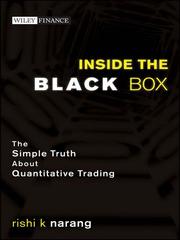
Inside the Black Box

Inside the Black Box

Rishi K. Narang
2009
T3 224 pages · about 3h 44m to read Open Librarygoodreads

Plain-language description of what quant trading systems do.

Summary

Narang, who has worked in and allocated to quantitative funds, wrote a structural explanation of how systematic trading strategies are built, aimed at investors and allocators rather than at quants building them.

The organising contribution is decomposition. He argues that any quantitative trading system consists of identifiable modules, and that understanding a fund means understanding each. The alpha model generates the forecast and can be theory-driven, using price data through trend and mean reversion or fundamental data through value, growth, quality and sentiment, or data-driven, using statistical relationships without a prior theory. The risk model constrains exposures, either by limiting them or by penalising them in optimisation. The transaction cost model estimates what trading will cost, including commissions, spread and market impact, and Narang stresses that this module determines whether a signal is tradeable at all. The portfolio construction model combines the forecast, the risk constraints and the cost estimates into target positions, using optimisation or rules. The execution model implements the trades, choosing algorithms and venues. Data and research infrastructure sit underneath all of it.

He then covers high-frequency trading separately, explaining market making, arbitrage and the structural role these firms play, and addresses the arguments about their effect on markets.

The diligence chapters are the practical payoff: what an allocator should ask about each module, what answers indicate a problem, and how to think about capacity, crowding and the risk that many funds hold the same positions, which he illustrates with the August 2007 quant deleveraging.

The book explains structure rather than teaching construction, so a practitioner will find it introductory. It also predates the widespread application of machine learning methods, alternative data and the substantial changes in market structure and capacity since 2009. Later editions update parts of this.

Key takeaways 7

  1. Any quantitative trading system decomposes into alpha, risk, transaction cost, portfolio construction and execution modules, and each can be evaluated separately.
  2. Alpha models are either theory-driven, resting on an economic reason a pattern should exist, or data-driven, resting on statistical relationship alone.
  3. The transaction cost model determines whether a signal is tradeable, and many valid signals fail on this test alone.
  4. Risk models constrain exposures the alpha model does not intend to take, which is what separates a strategy from a bet on a factor.
  5. Crowding is the principal risk in quantitative strategies, because similar models produce similar positions that unwind together.
  6. The August 2007 deleveraging demonstrated that funds with no common ownership can hold nearly identical positions.
  7. Capacity in a quantitative strategy is set by market impact, so returns decline as assets grow regardless of the model's quality.

Who should read it

Allocators and investors evaluating quantitative managers who need a vocabulary and a diligence framework for what happens inside the strategy.

Similar books 6

Chosen by shared topics, the entries that hold them, and the people who recommended both.

Barry Johnson · 2010

Execution algorithms and direct market access, from the desk.

Marcos López de Prado · 2018

Why standard machine learning fails on market data, and how to avoid false backtests.

Scott Patterson · 2012

How electronic trading and off-exchange venues took over.

Haim Bodek · 2013

Collected writings by the whistleblower on order-type abuse.
Larry Harris · 2002

How markets work: who trades, why, and how exchanges and orders set prices.

Where it sits in the reference 2

Business models
Investment styles

Topics

InvestingFinance and Markets