Updates

  1. Person pages list letters, writing, profiles and links as sortable tables with filters, and show each person's companies as links; Fund letters show each letter's description in its own column.
  2. Experts show a checked job title and a short description of each person; 30 more people have photographs.
  3. Every company, fund, university and publication the experts work for has a page listing the people there.
  4. Fund letters show each letter's thesis and filter by it; 225 person pages list the essays, columns and newsletter issues the person wrote.
  5. Person pages list every essay and newsletter issue a person wrote, and their own books as a table in List view.
  6. Recommends shows the five largest kinds of book and the rest under More; browse pictures load sooner.
  7. Podcasts and talks link the original episode, filter by Audio and video or Press, and list each publisher once.
  8. Pages are wider, Recommends has List and Grid, and a filter clicked again turns off.
  9. Book cards sit in a ruled grid with Open Library and Goodreads links and each book's one-line note.
  10. Funds is now Investors; each investor's styles are buttons that filter the table.
  11. Podcasts and talks on a person's page filter by year and publisher and show as a list or a grid of pictures.
  12. Quotes show only people's own words: 472 summaries written by list sites are gone.
  13. Country pages open from Browse again, and every link on the shelf lands on a page.
  14. Subject and person pages show their sections as tabs, and each book appears once on a person's page.
  15. Book cards show the quote, who said it and the source; grids show five cards to a row.
  16. On a phone, a menu holds the sections, search, Updates, Feedback and dark mode.
  17. Feedback takes a screenshot of the page with no browser prompt, opens a screenshot full size when you click it, and clears itself once sent.
  18. Book cards are centred, search names the topic each book sits in, and any text cut short shows whole on hover.
  19. Search groups its results by kind: people, companies, geographies, subjects, topics, books, funds, fund letters and papers.
  20. The Books table lists who recommended each book by name, and the browser tab names the section you are in.
  21. Feedback can take a screenshot of the page, or one you paste or choose, and opens in the corner beside Updates.
  22. Each rail button reopens its section where you left it, and Browse, Table and People show on every book and subject page.
  23. Filters grey out choices that hold nothing instead of hiding them, and Books › People filters by authors or recommenders.
  24. Feedback takes a subject line and up to three screenshots.
  25. Biographies are grouped by the person they are about: 41 new pages, from Abraham Lincoln to Lee Kuan Yew.
  26. Sport splits into 23 sports, and Religion into one topic per faith.
  27. Book lists show as cards: the cover, one recommendation quote and every recommender by name.
  28. Seventeen subjects that had two or three pages under different names now have one page each.
  29. Every page lists its Experts as authors and recommenders, with a link to them on the Experts tab.
  30. Economics, Financial history, Financial panics and Accounting are subjects of their own, with one page per financial crisis.
  31. Book, person and subject pages open inside the app, so the tabs stay in view.
  32. 996 more book covers, and photographs or logos for 227 more people and companies.
  33. Books › Browse shows every subject as cards, and the rail holds Fund letters, Papers, Experts, Books and Funds.
  34. Every topic over 150 books splits into narrower topics, each with a page of its own.

Send feedback

What is it?
Screenshots, up to 3 (optional)
or paste one with Ctrl+V

We use your email only to reply to you.

Algorithmic Trading and DMA

Algorithmic Trading and DMA

Barry Johnson
2010
T3 574 pages · about 9h 34m to read Open Librarygoodreads

Execution algorithms and direct market access, from the desk.

Summary

Johnson, an execution specialist, wrote a technical reference on how orders are actually executed in electronic markets, covering market microstructure, execution algorithms and direct market access.

The microstructure sections explain how modern markets work: order types, the limit order book, matching rules and priority, market fragmentation across venues, the different market models including quote-driven and order-driven markets, and the differences across asset classes and geographies.

The cost framework is the analytical foundation. Johnson decomposes execution cost into explicit components, meaning commissions, fees and taxes, and implicit components, meaning bid-ask spread, market impact from the order's own effect on price, timing risk from price movement during execution, and opportunity cost from unexecuted quantity. He explains implementation shortfall, which measures the difference between the price when the decision was made and the price actually achieved, and argues it is the correct benchmark because it captures everything.

The algorithm sections cover each family and what it optimises. Time-weighted and volume-weighted average price algorithms spread an order over a period to match a benchmark, which controls tracking error rather than cost. Percentage of volume algorithms participate at a set rate. Implementation shortfall algorithms trade off market impact against timing risk explicitly, trading faster when volatility is high. Liquidity-seeking algorithms search across venues including dark pools. He covers the parameters each exposes and how to select among them given order size, urgency and the security's liquidity.

The book is technical and written for practitioners. It is dated in market specifics since 2010, particularly on dark pools, on venue structure and on the regulatory framework in both the United States and Europe. The cost framework and the algorithm logic have not changed.

Key takeaways 7

  1. Execution cost decomposes into spread, market impact, timing risk and opportunity cost, and reducing one usually increases another.
  2. Implementation shortfall measures the difference between the decision price and the achieved price, which captures every cost component.
  3. Volume-weighted average price algorithms control tracking error against a benchmark rather than minimising cost.
  4. Trading faster reduces timing risk and increases market impact, so the correct speed depends on volatility and on order size relative to volume.
  5. Market impact rises with order size relative to average volume, which is the binding constraint on strategy capacity.
  6. Fragmentation across venues means the best price may exist somewhere the order does not reach without a liquidity-seeking algorithm.
  7. Algorithm selection should follow from order urgency, size and the security's liquidity rather than from convention.

Who should read it

Traders and portfolio managers who need to understand what execution actually costs and how algorithm choice changes it.

Similar books 6

Chosen by shared topics, the entries that hold them, and the people who recommended both.
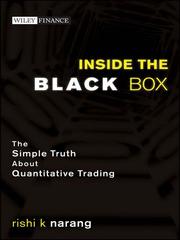
Rishi K. Narang · 2009

Plain-language description of what quant trading systems do.

Scott Patterson · 2012

How electronic trading and off-exchange venues took over.

Michael Lewis · 2014

How a trader uncovered high-frequency front-running and built the IEX exchange.

Recommended by: Mohnish Pabrai, Nat Eliason

Liam Vaughan · 2020

A trader in his parents' London house, and his link to the 2010 flash crash.

Ben Mezrich · 2021

GameStop and Citadel Securities' order flow; dramatised.

Marcos López de Prado · 2018

Why standard machine learning fails on market data, and how to avoid false backtests.

Where it sits in the reference 2

Business models
Investment styles

Topics

Finance and MarketsInvestingTechnology and ComputingCrypto and financial technology