Investing Amid Low Expected Returns: Making the Most When Markets Offer the Least
only 'Summary of Antti Ilmanen's Investing amid Low Expected Returns' by Irb Media, a study guide
About Antti Ilmanen
Principal and Global Co-Head of the Portfolio Solutions Group, AQR Capital Management; previously Brevan Howard and Salomon Brothers/Citigroup
Expected Returns is the standard practitioner survey of risk premia across asset classes and styles, and it sits on top of three decades of institutional bond and multi-asset work.
Who recommended it 2 · 2 direct
“My colleague and former classmate Antti Ilmanen is at it again with his second book, Investing Amid Low Expected Returns.”
“For an excellent discussion of the equity risk premium, see Antti Ilmanen, Investing Amid Low Expected Returns: Making the Most of When Markets Offer the Least (Hoboken, NJ: John Wiley & Sons, 2022), 55-69.”
Similar books 6
Chosen by shared topics, the entries that hold them, and the people who recommended both.
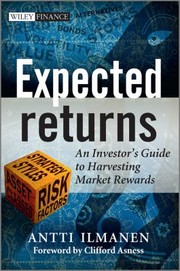
The evidence on what drives returns across asset classes: risk factors and behaviour.
“Ilmanen, Antti, Expected Returns: An Investor’s Guide to Harvesting Market Rewards (Hoboken, NJ: John Wiley & Sons, 2011)” — Michael Mauboussin
Source: Who Is On the Other Side? You Need Good BAIT to Land a Winner, page 40
Recommended by: Michael Mauboussin
A monograph on the expected returns of the major asset classes.
Markets pay skilled active managers; a survey of the strategies they run.
“Now another outstanding Nordic researcher (and AQR partner), Lasse Heje Pedersen, presents me with the same dilemma: His new book, Efficiently Inefficient (Princeton University Press), is fantastic — almost too good at laying out how successful professional asset managers think and act.” — Clifford Asness
Source: Efficient Inefficiency: The Oxymoron That Explains the Investing World
Recommended by: Clifford Asness, Michael Mauboussin
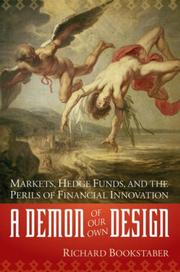
How financial innovation made markets more crisis-prone, from a risk manager.
“The New York Times of August 18 described A Demon of Our Own Design, by Richard Bookstaber (see “Investment Miscellany,” November 2000) as pointing out that “the proliferation of complex financial products like derivatives, combined with use of leverage to bolster returns, will inevitably mean that there will be a regular stream of market contagions like the one we’re having now – one of which, someday, could be calamitous.” 6” — Howard Marks
Source: Now It’s All Bad?, page 6
Recommended by: Howard Marks, Jeremy Grantham and 1 other
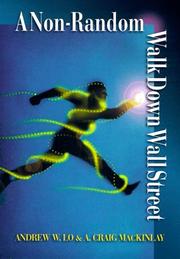
Research papers showing that stock prices do not follow a random walk.
“Andrew W. Lo and A. Craig MacKinlay, A Non-Random Walk Down Wall Street (Princeton, NJ: Princeton University Press, 1999), 4-5” — Michael Mauboussin
Source: Capital Ideas Revisited - Part 2: Thoughts on Beating a Mostly-Efficient Stock Market, page 9
Recommended by: Michael Mauboussin
Stock prices follow a random walk, so a low-cost index fund beats stock picking.
“Even earlier, in 1973, in his classic A Random Walk Down Wall Street, Burton G. Malkiel had called for such a fund, although, alas, when we started it, I had yet to read his book.” — John C. Bogle
Source: CONVERGENCE!, page 1
Recommended by: Jason Zweig, John C. Bogle and 5 others
Where it sits in the reference 1
Topics 1
As an Amazon Associate I earn from qualifying purchases.