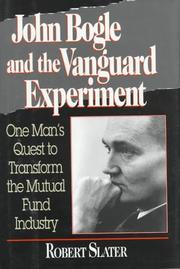
John Bogle and the Vanguard Experiment
John Bogle and Vanguard, written when index funds were still a minority of assets.
The only biography; stops two decades before indexing won.
Summary
Slater, a journalist who wrote several business biographies, produced this account of John Bogle and Vanguard in 1996, when the firm was large but not yet dominant and when index funds were still a minority of assets.
The narrative covers Bogle's Princeton thesis on the mutual fund industry, his career at Wellington Management, the merger with a Boston firm that ended with Bogle being fired in 1974, and the creation of Vanguard from that defeat. Slater documents the structural device: Bogle persuaded the fund directors to have the funds themselves acquire the administrative operations, which made the funds their own owner and removed the external management company's profit. He then covers the 1976 launch of the First Index Investment Trust, the industry's derision, the slow accumulation of assets, the addition of bond and money market funds, and the growth through the 1980s and early 1990s.
The argument is Bogle's own, which Slater reports rather than tests: that costs are the only reliable predictor of relative fund performance, that the average active manager must underperform the market by the amount of fees and trading costs, and that the industry's structure prevents it from acting on this.
The book is now dated in the way that matters most. It was written before indexing became the dominant form of equity ownership, before exchange-traded funds, before the fee compression of the 2000s and 2010s, and before Vanguard's assets grew by more than an order of magnitude. Balchunas's The Bogle Effect and Ellis's Inside Vanguard, both in this reference, cover the full arc. Slater's account is useful mainly as a record of how the firm and the argument looked when the outcome was still uncertain.
Key takeaways 7
- Vanguard's funds own the management company, which removes the external owner's profit from the cost investors pay.
- Bogle created the structure after being fired from Wellington, and it was a solution to a governance dispute as much as a philosophical position.
- The first index fund launched in 1976 raised a small fraction of its target and was ridiculed by the rest of the industry.
- Costs are the most reliable predictor of a fund's performance relative to its peers, which Bogle argued from the arithmetic rather than from data alone.
- The average active manager must underperform the market by the amount of fees and trading costs, because active managers collectively are the market.
- Adding bond and money market funds rather than more equity products was what gave Vanguard scale in its first decade.
- The fund industry's ownership structure prevents it from competing on cost, because the management company's profit depends on the fees.
Who should read it
Readers who want a contemporaneous account of Vanguard before indexing won, though later books cover the full story.
Similar books 6
Chosen by shared topics, the entries that hold them, and the people who recommended both.
How John Bogle and Vanguard changed the fund industry and cut investors' costs.
How index funds went from academic idea to owning much of the world's shares.
“Wigglesworth, Robin, Trillions: How a Band of Wall Street Renegades Invested the Index Fund and Changed Finance Forever (New York: Portfolio/Penguin, 2021)” — Michael Mauboussin
Source: Who Is On the Other Side? A Framework for Understanding Market (In)Efficiency
Recommended by: Michael Mauboussin
An institutional history of Vanguard from its founding to after Jack Bogle's death.
T. Rowe Price, his firm and the growth investing he named, from his own papers.
How costs, turnover and fund structure decide what mutual fund investors earn.
“The founder of the Vanguard Group and father of the index-fund industry methodically sorts fact from fiction. Following his logical arguments can benefit you even if you never invest in a mutual fund, since Bogle touches on just about every crucial aspect of investing, including taxes, trading costs, diversification, performance measurement and the power of patience.” — Jason Zweig
Source: Best Books for Investors: A Short Shelf — jasonzweig.com
Recommended by: Jason Zweig, Michael Mauboussin and 4 others
A short address on Vanguard's history, given by its founder to the Newcomen Society.