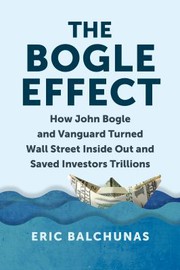
The Bogle Effect: How John Bogle and Vanguard Turned Wall Street Inside Out and Saved Investors Trillions
How John Bogle and Vanguard changed the fund industry and cut investors' costs.
Bloomberg analyst on Vanguard's economics
Summary
Balchunas, a Bloomberg exchange-traded fund analyst, wrote about John Bogle's effect on the asset management industry rather than a biography, drawing on interviews with Bogle before his death and on industry data.
His central quantitative argument is the estimate he calls the Bogle effect: the amount investors save annually because of the fee compression Vanguard forced across the whole industry, which he puts at roughly a quarter of a trillion dollars a year when the fees actually charged are compared with what would have been charged at earlier rates. He argues that the savings to investors outside Vanguard exceed those to Vanguard's own clients, because competitors cut fees to retain assets.
The structural analysis covers the mutual ownership arrangement, in which the funds own the management company so surpluses return to shareholders as lower costs, and Balchunas argues this is unreplicable: no competitor can adopt it without destroying its own economics, which is why the advantage has held.
He also covers what he calls the Vanguard effect on flows, the growth of index funds to a majority of American equity fund assets, the exchange-traded fund business and Vanguard's unusual share-class structure, and the areas where Bogle's own views and the industry diverged, particularly Bogle's opposition to exchange-traded funds on the grounds that tradability encourages the behaviour indexing was meant to prevent.
Balchunas addresses the criticisms of index concentration, including the common ownership arguments and the governance questions raised by three firms holding large stakes in most public companies, though not at length.
The book is admiring and written by someone who covers the industry professionally. The fee savings estimate depends on a counterfactual about what fees would otherwise have been, which cannot be verified. It is more analytical and more distant than Ellis's Inside Vanguard, also in this reference.
Key takeaways 7
- Fee compression forced by Vanguard saves investors across the whole industry more than it saves Vanguard's own clients.
- The mutual ownership structure cannot be copied by a competitor without destroying that competitor's existing economics.
- Index funds passed active funds as a share of American equity fund assets, which reversed the industry's structure within one career.
- Bogle opposed exchange-traded funds because tradability encourages the trading behaviour that indexing was designed to prevent.
- Vanguard's exchange-traded funds were structured as share classes of existing mutual funds, which no competitor could replicate.
- A cost advantage that grows with scale is more durable than any advantage based on investment performance.
- Concentration of index assets in a few managers raises governance questions that the cost savings do not answer.
Who should read it
Investors and asset management operators who want the industry-wide effect of indexing quantified and the structural reasons the advantage persists.
Similar books 6
Chosen by shared topics, the entries that hold them, and the people who recommended both.
John Bogle and Vanguard, written when index funds were still a minority of assets.
How index funds went from academic idea to owning much of the world's shares.
“Wigglesworth, Robin, Trillions: How a Band of Wall Street Renegades Invested the Index Fund and Changed Finance Forever (New York: Portfolio/Penguin, 2021)” — Michael Mauboussin
Source: Who Is On the Other Side? A Framework for Understanding Market (In)Efficiency
Recommended by: Michael Mauboussin
An institutional history of Vanguard from its founding to after Jack Bogle's death.
T. Rowe Price, his firm and the growth investing he named, from his own papers.
How costs, turnover and fund structure decide what mutual fund investors earn.
“The founder of the Vanguard Group and father of the index-fund industry methodically sorts fact from fiction. Following his logical arguments can benefit you even if you never invest in a mutual fund, since Bogle touches on just about every crucial aspect of investing, including taxes, trading costs, diversification, performance measurement and the power of patience.” — Jason Zweig
Source: Best Books for Investors: A Short Shelf — jasonzweig.com
Recommended by: Jason Zweig, Michael Mauboussin and 4 others
A short address on Vanguard's history, given by its founder to the Newcomen Society.